
The brown PSG pattern is the desert colourway of the Philippine Presidential Security Group’s blocky “bricks” design: a four colour scheme of hard-edged, straight-sided blocks in brown, dark brown, sand and white, worn by the president’s own security force since 2004 and also called PSG desert camouflage.
| Country | Philippines |
|---|---|
| Pattern type | Four colour rectilinear block design (desert colourway) |
| In use | From 2004 (archived Kamouflage.net data) |
| Status | In service with the Presidential Security Group |
| Colours | Brown, dark brown, sand and white blocks |
| Used by | Presidential Security Group (PSG) |
Design
The design is made of hard-edged rectangular blocks, closer to a city plan than to foliage, and the brown version keeps exactly the geometry of the grey PSG design that came before it, changing only the colours. The archived Kamouflage.net data gives the brown colourway as brown, dark brown, sand and white. Camopedia, documenting the bricks family as a whole, lists three primary colourways: grey and black, grey black and tan, and a tan variation with pinkish hues. Those lists do not match each other exactly, and no official colour specification is published, so the archived four colours are given here as the record for this colourway and Camopedia’s list as the record for the family. The design began as paint: Camopedia records that the PSG started painting its vehicles in the grey-black urban scheme, nicknamed “bricks”, in 1989, and that uniforms in the pattern were adopted by 1991 at the latest. A camouflage whose first job was to mark out one unit’s vehicles and men is as much an identification device as a concealment one, and write ups of the grey version say openly that distinguishing PSG soldiers from other troops was part of the point.
History
The Presidential Security Group guards the President of the Philippines and the presidential palace in Manila. The grey PSG design grew out of the years after Ferdinand Marcos fled in February 1986, when military rebels attempted a series of coups against President Corazón Aquino and a palace guard that could be told apart at a glance had real value. The brown colourway is a later evolution of that same design. The archived page dates it from 2004 and is candid that its provenance is obscure: its author supposed that a desert colour scheme might reflect the Philippines’ support for the United States after 2001 and its small contingent in Iraq, which was withdrawn in July 2004. That connection is the original author’s supposition, recorded here as such; no source checked confirms why a desert colourway was wanted in a tropical country, and the date itself rests on the archived data.
Identification notes
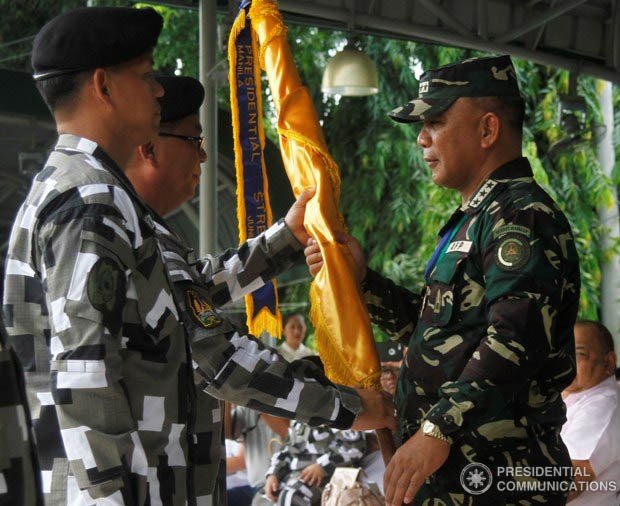
Against the grey PSG colourway of the same design: the block geometry is identical, and only the palette separates them, greys and white for the city version, browns and sand for this one. A tan bricks uniform with pinkish tones is also documented by Camopedia and sits close to this colourway; shade alone is a weak separator between the two tan versions. Against the American USMC T-Pattern, the other famous hard block design in this database: the T-Pattern was a 1999 trial print in greys that was never issued, while the PSG design is a Philippine service pattern painted on vehicles from 1989 and worn in several colourways. Philippine troops today also wear pixelated patterns with squared shapes; the PSG bricks blocks are larger, straight sided and not pixel built, and PSG insignia and context are the practical pointers.
Related patterns: USMC T-Pattern (Urban Camouflage Pattern).
Image: Presidential Security Group officers at a change of command ceremony in 2016, photographed by Marcelino Pascua for the Presidential Communications Operations Office, public domain, via Wikimedia Commons. The officers at left wear the grey colourway of the same bricks design; no freely licensed photograph of the brown desert colourway has been found.