
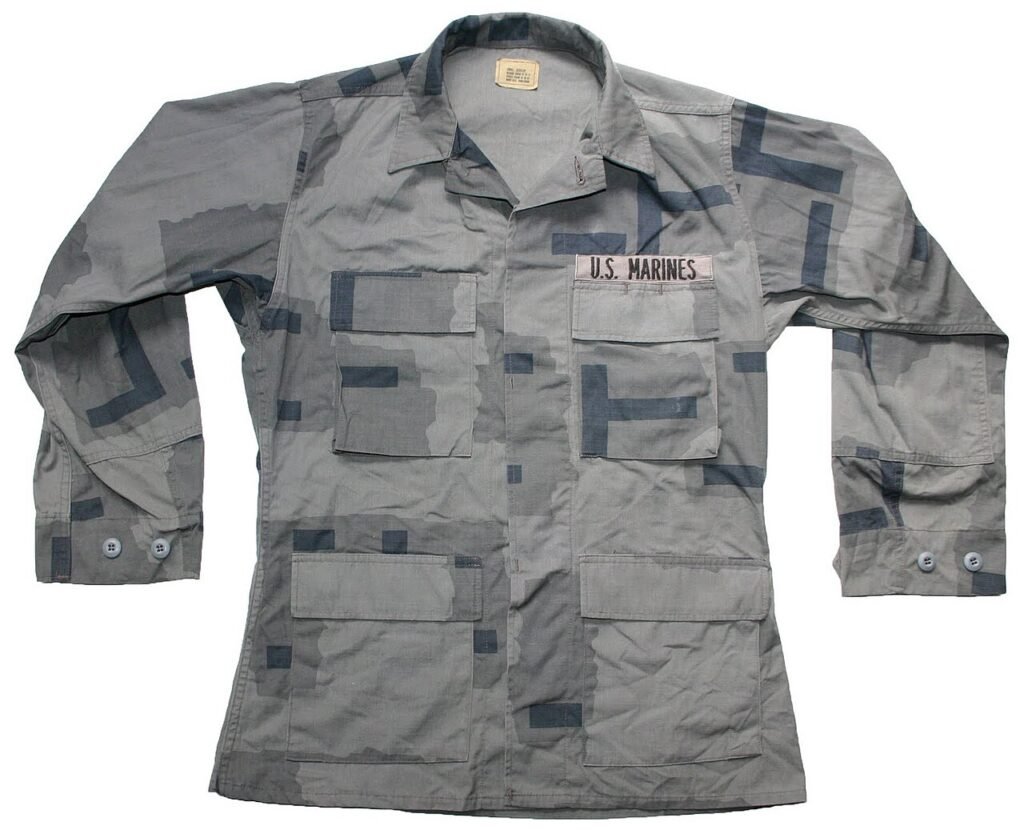
The Urban Camouflage Pattern, better known as the T-pattern or T-block, was worn for exactly four days. The U.S. Marine Corps created it for Operation Urban Warrior, its March 1999 exercise in the San Francisco Bay Area, issued it as a full set of trial clothing, and never used it again. It remains the most famous American urban camouflage experiment.
| Country | United States |
|---|---|
| Pattern type | Three colour urban pattern of large angled block elements |
| Introduced | March 1999, for Operation Urban Warrior |
| Status | Trial only; never used after the exercise |
| Colours | Three: large regular medium grey and angled black elements on a grey background |
| Used by | USMC personnel participating in Operation Urban Warrior, 15 to 18 March 1999 |
Design
Large, regular medium grey shapes and distinctive angled black elements on a grey background: a pattern of straight edges and blocky forms meant to echo the horizontal and vertical lines of built up areas, and the source of the T-block nickname. It is also catalogued as Marines T-Pattern, USMC T-Pattern, Marines Urban Trial and Tpat. Unlike the woodland and lizard derived designs around it, the T-pattern’s geometry is architectural rather than organic, which is why it still looks modern next to its contemporaries. The original kamouflage.net’s data also records use by a Royal Marines group, reflecting British participation in the urban warfare experiments of the period.
History
Operation Urban Warrior, staged in the San Francisco Bay Area in March 1999, was the Marine Corps’ major effort to refine its strategy for an increasingly urbanised world, on the reasoning that potential enemies, having watched Desert Storm, would choose cities precisely because narrow streets, confusing layouts and large numbers of civilians limit American technological superiority and firepower. For the occasion the Corps fielded this experimental pattern for Military Operations on Urbanised Terrain (MOUT). Participants were issued a BDU jacket and trousers, a boonie hat, a helmet cover and a flak vest cover in the pattern, and instructed to wear it for the duration of the exercise, 15 to 18 March 1999. After that, it was never used again, and original trial garments became collector pieces. The exercise itself is also remembered for the allegation, carried in the original site’s caption, that the Marines tested skateboards as a means of detecting tripwires and snipers. The U.S. military’s urban camouflage story continued with the Natick MOUT prototypes and, commercially, with the grey woodland recolour catalogued on this site as the U.S. ‘urban’ camouflage, but no official urban pattern followed the T-pattern into service.
Identification notes
Large angled black and medium grey blocks on grey, in BDU cut garments with 1999 trial provenance: that is the T-pattern. Against the U.S. ‘urban’ woodland recolour: that pattern keeps the organic woodland shapes in greys, while the T-pattern’s elements are regular and geometric. Against the later UCP: UCP is pixelated blotches in tan, grey and sage green, with no black and no large blocks. Against the USAF blue tiger stripe prototype: tiger stripes, however coloured, are flowing strokes, not blocks.
Related patterns: U.S. ‘Urban’ Camouflage, Polish Metro Pattern.
Image: Collectorofinsignia, CC BY-SA 3.0, via Wikimedia Commons. The photograph shows an original T-pattern BDU coat from Operation Urban Warrior, March 1999.