
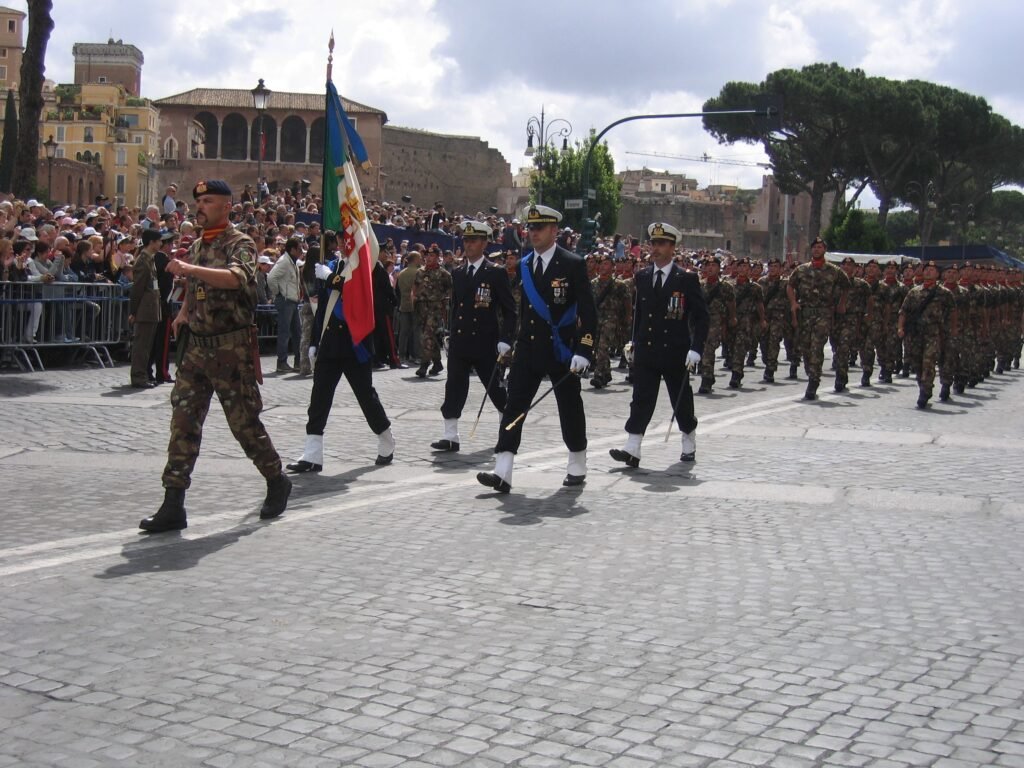
When Italy finally retired the telo mimetico in 1992, the Army took a woodland pattern and the Navy’s San Marco marines took one of their own: a five colour design of soft-edged, irregular blotches in black, chocolate brown, medium green and white on a light tan ground, worn by no other Italian formation.
| Country | Italy |
|---|---|
| Pattern type | Five colour disruptive pattern |
| In use | From 1992 (archived Kamouflage.net data) |
| Status | Superseded by mimetico Vegetata when the Navy adopted it in the early 2010s |
| Colours | Black, chocolate brown, medium green and white blotches on a light tan ground |
| Used by | Reggimento San Marco (Battalion San Marco at adoption), Marina Militare |
Design
The shapes are irregular blotches with soft, almost sprayed edges, quite unlike the amoeba-like shapes of the telo mimetico it replaced. Camopedia describes the San Marco design as an “airbrush” style pattern and records that it spawned variants for beach assaults, mountainous regions and desert operations, and a version for the Navy’s COMSUBIN special forces; the standard temperate version is the subject of this page. Production came in batches rather than one unchanging print. Joint Forces, examining surviving uniforms, distinguishes an original early 1990s batch, a 1998 contract batch with minor detail differences and a white backed fabric, and a final 2009 contract batch of more modern cut with the fabric printed on both sides. Shade and detail therefore vary between genuine uniforms, and no single swatch defines the pattern.
History
The San Marco regiment is the Italian Navy’s marine infantry, named for Saint Mark after the defence of Venice in the First World War and carrying the winged lion as its badge. Disbanded in 1956 and reactivated as a battalion in the mid-1960s, it was expanded back to regiment strength in the 1990s. The archived Kamouflage.net page dates this pattern to 1992, the year the telo mimetico was withdrawn: the Army adopted a woodland pattern, and the Battalion San Marco adopted this design, specific to the formation. Camopedia instead says the San Marco marines were the first Italian unit to receive an entirely original camouflage pattern, in the late 1980s. The two accounts are set out here as they stand; the surviving contract uniforms documented by Joint Forces begin in the early 1990s. The pattern served through the 1990s and 2000s, and its end came when the Navy as a whole adopted the M04 mimetico Vegetata: in 2013 the regiment was incorporated into the new Brigata Marina San Marco and issued Vegetata uniforms.
Identification notes
Against the telo mimetico: the telo family is a three colour design of amoeba-like shapes running back to 1929, with no white and no pale tan ground; the San Marco pattern has five colours, white among them, on light tan, with softer sprayed edges. Photographs of San Marco men in a blue toned telo print show the earlier Navy variant of the shelter cloth family, not this pattern. Against the Army’s Roma 90 woodland of the same years: Roma 90 follows the American M81 woodland geometry in greens and browns, without the San Marco pattern’s white blotches and tan ground or its airbrushed edges. Against its successor, mimetico Vegetata: Vegetata mixes its shapes with tiny flecks and a pixel-like breakup, where the San Marco print is smooth blotches throughout.
Related patterns: Italian M29 Telo Mimetico Camouflage, Second Pattern.
Image: the San Marco Regiment on parade in Rome, 2 June 2007, photographed by Jollyroger, CC BY-SA 2.5, via Wikimedia Commons. The regiment’s own pattern is worn by the officer at left and by the marching troops behind the colour party.