
Urban MARPAT is the colourway that never was: the Marine Corps’ digital pattern redrawn in greys for city fighting, tested alongside the woodland and desert versions in 2000 and 2001, kept on paper, and never authorised for issue.
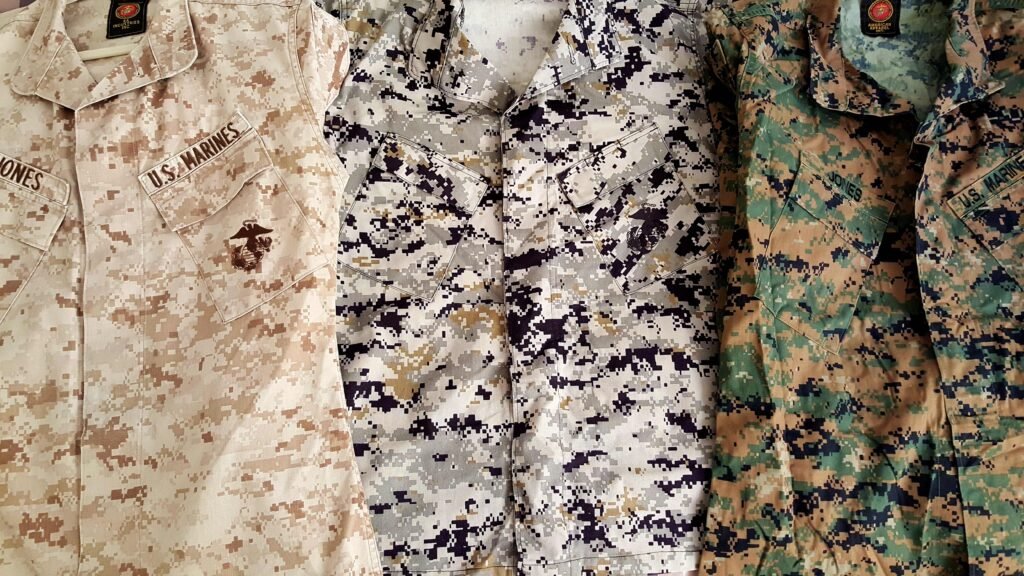
| Country | United States |
|---|---|
| Pattern type | Digital (pixelated), urban colourway of MARPAT |
| Developed | 2000 to 2001, in the MARPAT programme |
| Status | Prototype only; never authorised for issue |
| Colours | Four, a greyscale (no official colour list was published) |
| Developed for | United States Marine Corps |
Design
The construction is identical to the issued colourways: small rectangular pixels forming macro shapes that are not meant to resolve into any recognisable shape at distance, with the Marine Corps emblem embedded in the print. Only the palette changes, a greyscale described consistently by observers as white, light grey, a darker grey and black. No official colour names or codes were ever published for it, and this page prints none. One family dispute should be recorded rather than settled: the archived Kamouflage.net page argues that MARPAT derives directly from Canada’s CADPAT under a bilateral exchange, citing the CADPAT project manager, while an account by one of the MARPAT designers denies any Canadian consultation. Both positions exist in the record; the dispute is about the family, not this colourway in particular.
History
The Marine Corps began the MARPAT programme in April 2000 and tested three colourways from the start: woodland, desert and urban. The pattern was patented in 2001 and field trials ran that year; on 17 January 2002 the woodland and desert colourways were adopted, and they were issued from late 2002. The urban colourway was not adopted. The Marine Corps kept the rights to it, and the Smithsonian’s record for a trial helmet cover states the position plainly: the urban pattern has not been authorised by the Marine Corps for wear. One documented factor in the decision is that desert MARPAT placed first in U.S. Army urban environment testing, and in Iraq and Afghanistan Marines fought in urban terrain in desert MARPAT, which settled the question the urban colourway had been designed for. The grey MARPAT style uniforms sold commercially are unauthorised replicas of the trial pattern.
Identification notes
Against the T-pattern: that is an analogue pattern of large, hard, blocky shapes from the 1999 Operation Urban Warrior exercise, and it predates MARPAT. Blocky hard shapes and a 1999 exercise context mean T-pattern; grey pixels mean Urban MARPAT. Against the U.S. ‘Urban’ camouflage: that is the M81 woodland artwork recoloured in greys, analogue woodland blobs from about 1990. Grey woodland shapes are the M81 recolour; grey pixels are this pattern. Against the Army’s UCP: UCP is a three colour digital in sage green, grey and sand, adopted in 2004 and issued in huge numbers; an issued, labelled Army uniform is UCP, not Urban MARPAT. Against faded woodland MARPAT, the commonest trap: fading greys out the woodland print, so check for surviving green or brown pixel tones and for labels, since no urban uniform was ever issued, an issue label cannot confirm one.
Related patterns: Woodland MARPAT, USMC T-Pattern (Urban Camouflage Pattern), U.S. ‘Urban’ Camouflage.
Image: the three MARPAT colourways tested in 2000 and 2001, photographed by Cupkakekilla, CC BY-SA 4.0, via Wikimedia Commons. From left: Desert, the prototype Urban in greys, and Woodland. No flat swatch of the urban colourway is freely licensed.