
The KLMK coverall was reversible, and this page covers its second face: the sun-spot print of the obverse showing through the cloth, overprinted with a fine light pattern of small checks. It is paler, quieter and far less photographed than the famous face, and why it was made at all is still argued about.
| Country | USSR |
|---|---|
| Pattern type | Reverse face of a two colour reversible print, with a light grid and check overprint |
| In use | On KLMK coveralls issued from 1968/69 (archived Kamouflage.net data: 1969–present); late production suits from the late 1980s were made without the reversible grid |
| Status | Historic; belongs to the earlier production of the KLMK coverall |
| Colours | The obverse colours showing through the cloth, much paler, under a light coloured grid and check overprint |
| Used by | Soviet VDV (airborne), KGB frontier troops (PV KGB), land forces and GRU spetsnaz; the grid reverse also recorded in use by Kazakhstan, Uzbekistan and, from 1991, Belarus |
Design
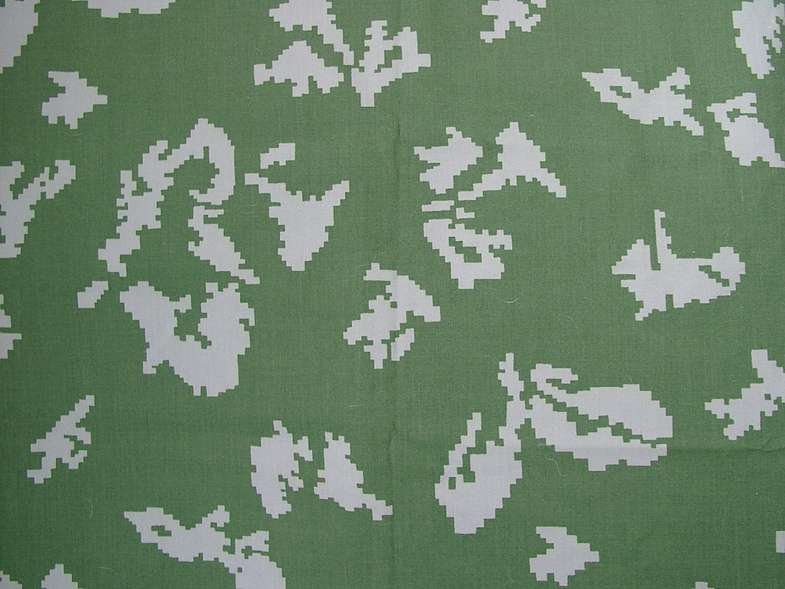
The reverse face is not a separate print run in the ordinary sense. The solnechnyye zaychiki design of the obverse, light stepped spots on an olive ground, bleeds through the thin coverall cloth, and the back of the fabric carries its own light overprint on top of that ghost image. The archived Kamouflage.net page describes the overprint as a pattern of small hound’s-tooth checks; the ICUS Camouflage Index describes jagged tan shapes on a grid-like green and tan field, the shapes showing through from the obverse. The two wordings describe the same construction from different sides: a fine light grid and check laid over the print showing through. The result reads as a pale, even, faintly checked surface, a deliberate second camouflage rather than an unfinished back.
History
The KLMK coverall was issued in 1968/69, and the archived page calls it the last one piece camouflage uniform ever issued to the armed forces of the USSR. The reverse face belongs to the suit’s earlier production: suits made from the late 1980s into the early 1990s dropped the reversible grid, so a coverall with this face dates from the first two decades of production. What the face was for is genuinely unsettled, and this page leaves it unsettled. Dennis Desmond, in Camouflage Uniforms of the Soviet Union and Russia, 1937 to the Present, states that the pattern was intended for wear in snowy or sandy terrain. The archived page records a rival suggestion: that the check is an interference pattern meant to defeat the pixelised displays of early night vision systems, by analogy with the grid of the American Desert Night Camouflage parka, and the suit itself was developed in the context of countering NATO night vision devices. No source checked settles the question between the two.
Identification notes
Against the obverse face of the same garment: the obverse carries bold light stepped spots on a darker olive ground, while the reverse has no bold spots at all, only the ghost of the shapes under the fine light grid and check, and reads much paler and more uniform. Against the Soviet PV KGB pattern: that is a separate garment printed with the KLMK design mirrored, a print in its own right; the reverse face is the back of the obverse cloth with its check overprint, not a mirrored print. Against the American Desert Night Camouflage: that is a purpose printed two colour grid on its own parka fabric, while the KLMK reverse shows the sun-spot shapes through the cloth beneath its grid.
Related patterns: Soviet KLMK Pattern (Solnechnyye Zaychiki), Soviet PV KGB Camouflage Pattern.
Image: the obverse face of the same KLMK coverall, photographed by GTRus, CC BY-SA 4.0, via Wikimedia Commons. No freely licensed photograph of the reverse face is known; the image shows the print that shows through on the reverse.