
Solnechnyye zaychiki, “sun bunnies”, the patches of dappled sunlight, is the outer face of the Soviet KLMK coverall of 1968: light angular spots with stepped, toothed edges on an olive green ground. It looks like an early digital pattern, and Western collectors called it the “computer pattern”, but it was printed by ordinary 1960s methods. It became the visual shorthand for Soviet special forces.
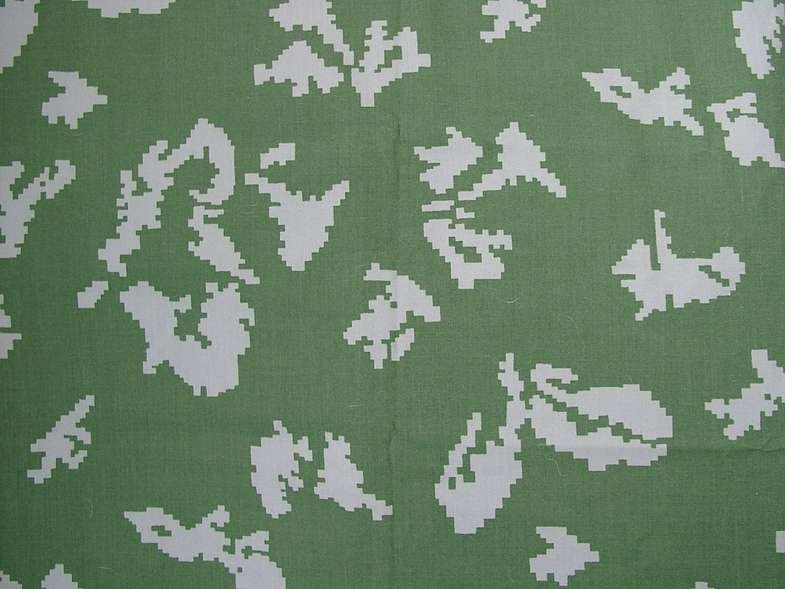
| Country | USSR |
|---|---|
| Pattern type | Two colour stair step pattern |
| Introduced | Developed 1968, in service from 1969 |
| Status | Still in production and use in Russia and successor states |
| Colours | Two: light grey spots, or yellow sand spots, on an olive green ground |
| Used by | KGB Border Guards first; also VDV airborne, GRU spetsnaz and engineers |
Design
Irregular light blotches whose edges are built from small squares, giving the stepped, toothed look, printed on a medium olive green ground that is always darker than the spots. Two obverse colourways are documented: light grey spots on olive green, the “silver leaf” (serebryanyi list) version, and yellow sand spots on olive green, used mainly by KGB Border Guards; occasional swamp toned grounds occur. The pattern is a much simplified descendant of the design on the 1961 paratroopers’ KLMK uniform. Its other names tangle: Berezka or Berezhka, “birch”, is applied to the whole family and to the KZS suit as well, and the 1981 spetsodezhda is a related later variant, not this pattern. Specialist writers explicitly reject the “computer designed” implication of the Western nickname.
History
The pattern was developed in 1968 and first appeared on the one piece 1968/69 KLMK overalls, in service from 1969. KLMK expands as kamuflirovannyi letnii maskirovochnyi kombinezon, camouflaged summer disguise coverall. It was first issued to KGB Border Guards, and also used by VDV airborne troops, GRU spetsnaz and Soviet land forces including engineers, extensively in the Soviet Afghan War. From 1975 the same pattern family was printed on the two piece KZS suit, a coarse burlap like loose weave suit designed for chemical troops and disposable after chemical exposure. The KLMK coverall was reversible: the obverse carries this stair step pattern, and the reverse carries a fine grid or mesh pattern in the same colours, the suit having been developed in the context of countering NATO night vision devices; late production suits, from the late 1980s and early 1990s, were made without the reversible grid. The pattern family remains in production and use: KLMK two piece suits were still in production in 2018, and the design is worn post 1991 by Russian spetsnaz, VDV, engineer and Cossack units and by several successor states, including Belarus, Tajikistan’s border guards and Ukraine. Clones of the KLMK were even made for the films Red Dawn and Rambo III.
Identification notes
Two colours only, with light stepped square spots on a darker olive ground, separates the KLMK from three colour Soviet patterns such as TTsKO (Butan), from the smooth blobs of the 1938 amoeba, and from the naturalistic printed leaves of the 1941 leaf pattern. Grey spots against sand spots mark the two obverse colourways. The KZS version is identifiable by its coarse, burlap like fabric, and a fine grid print on the inside of a coverall identifies the reversible KLMK. It also descends from the stair step idea first seen in the TTsMKK of 1944, whose shapes are far larger and drawn in three colours.
Related patterns: Soviet TTsMKK Pattern 1944/45, Soviet Leaf Pattern 1941.
Swatch image: GTRus, CC BY-SA 4.0, via Wikimedia Commons. The swatch shows the Berezka (KLMK) camouflage pattern.