
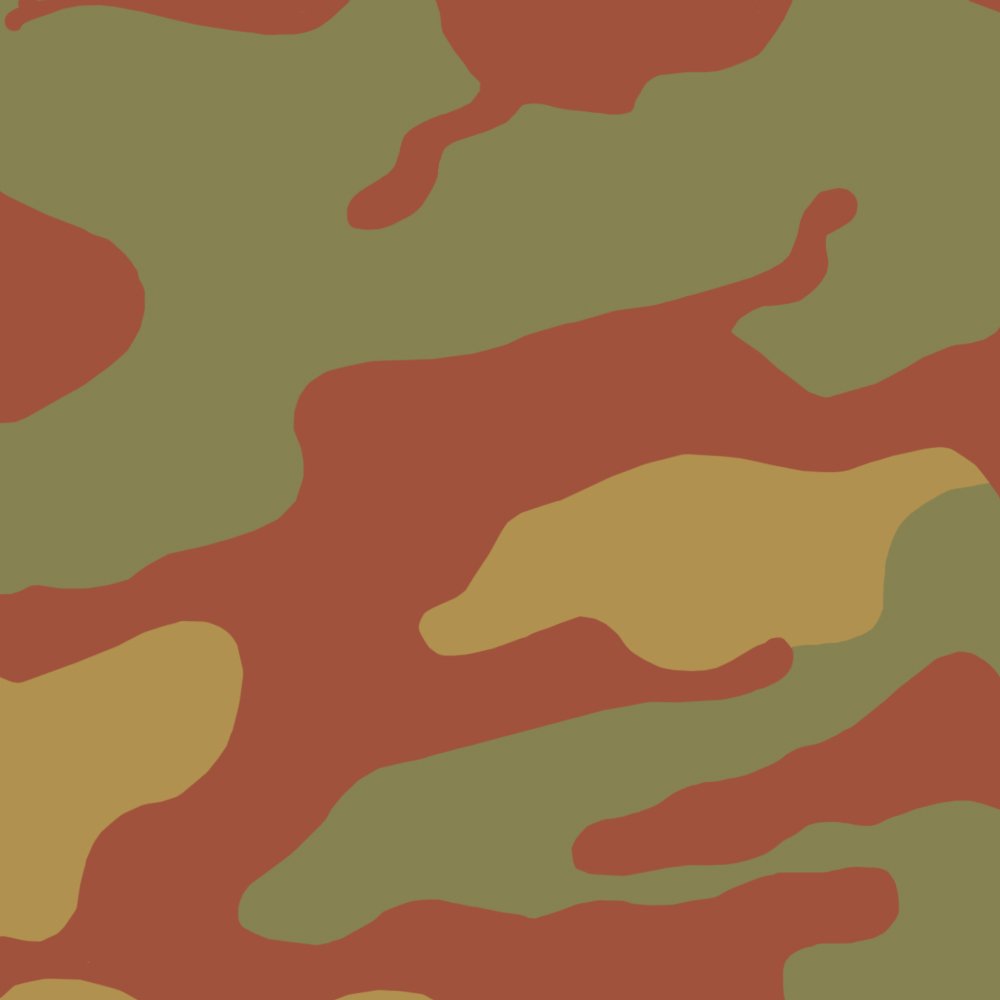
This page covers the same M29 second pattern print as the main second pattern page, in the greyer, redder brown colour variation recorded from a shelter half dated 1952. The drawing is identical to the second pattern’s: same shapes, same scale, same compression. Only the colours differ. The full history of the M29 family is on the Italian M29 Telo Mimetico (Second Pattern) page and is not repeated here.
| Country | Italy |
|---|---|
| Pattern type | Three colour blotch pattern; colour variation of the second pattern |
| Introduced | 1929 (second pattern print before the Second World War) |
| Status | Retired (the M29 family served until the early 1990s) |
| Colours | Greyish yellowish brown, greyish olive green and greyish reddish brown, as recorded from the 1952 shelter half |
| Used by | Italian Army, and German forces using captured stocks in 1943 to 1944 |
| Specimen | Shelter half dated 1952, the piece this colour record comes from |
The colour variation
The original Kamouflage site carried this as a separate page because the specimen behind it, a shelter half dated 1952, was printed in colours that differ from the specimen behind the main second pattern page. Put side by side, the two records read: moderate yellowish brown, greyish olive and moderate brown on the main page’s post war garment, against greyish yellowish brown, greyish olive green and greyish reddish brown on the 1952 shelter half. The second record is greyer overall, and its brown leans red. The 1952 text itself notes that its colours are probably one of six or more colour variations of the pattern. Colour drift is a property of M29 production: over the pattern’s long life the colours became brighter and the print less crisp, and collectors debate whether the colour versions were deliberate variants or the product of different makers, batches and age.
Wartime and post war colours
One colour separator does hold across the family. Wartime M29 cloth is chocolate brown, greyish green or green, and yellow ochre, and it never shows blue. Post war production adds red brown and a distinct blue or turquoise tone. By that test the 1952 shelter half still sits on the wartime side of the line: its palette is greyish with a reddish brown, and there is no blue or turquoise in it. So this variation is not the bright post war colourway either. It is one of the intermediate colour states of the same print, which is why this page treats it as a colour record worth keeping rather than a separate pattern.
Identification notes
Against Italian M29 Telo Mimetico (Second Pattern): same drawing, same scale, same shapes. The separator is only the recorded palette: this variation is greyer overall, its green a greyish olive green and its brown a greyish reddish brown, against the warmer yellowish brown and greyish olive of the main page’s specimen. Against wartime M29 cloth generally: wartime production never shows blue or turquoise, so any M29 cloth with a blue or turquoise element is post war production. Against the first and third M29 patterns: the second pattern is the first pattern’s drawing compressed, 87 percent across and 75 percent along, so its shapes look squeezed in one direction beside the first pattern; that test applies to this variation and the main second pattern page equally.
Related patterns: Italian M29 Telo Mimetico (Second Pattern), Reggimento San Marco Camouflage Pattern, Italian ‘Somalia’ Desert Camouflage Pattern.
Swatch image: Thimbleweed, CC BY-SA 3.0, via Wikimedia Commons. The swatch shows the post war (1960s) colour variant of the same M29 drawing, redrawn from an actual specimen; it is not the 1952 shelter half described above. Placed beside the wartime swatch on the second pattern page, it shows how far the colours of one drawing could drift.