
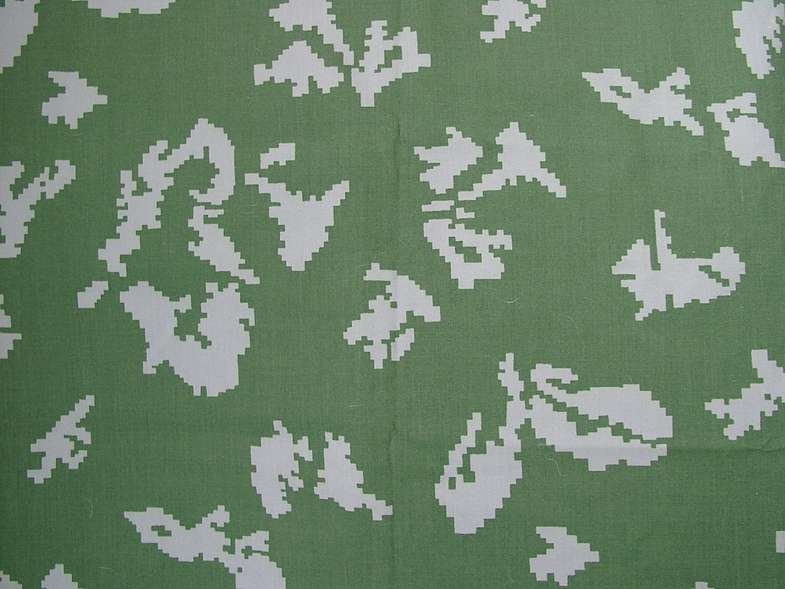
In 1981 the KGB’s Frontier Troops fielded a sturdy two piece special purpose uniform, the Type 1 spetsodezhda, printed with a two colour stair-step pattern in yellow on olive green. Collectors call it the computer, laser or sun-ray pattern. Its print is the familiar solnechnyye zaychiki design turned mirror-wise.
| Country | USSR |
|---|---|
| Pattern type | Two colour stair-step pattern |
| In use | 1981–1991 (archived Kamouflage.net data); the uniforms remained in use after 1991 |
| Status | Soviet issue ended with the USSR; surviving uniforms still circulate |
| Colours | Yellowish-green or bright yellow stair-step shapes on an olive green field |
| Used by | KGB Frontier Troops (PV KGB), KGB osnaz special purpose units, Soviet 103rd Guards Airborne Division |
Design
The pattern belongs to the Soviet leaf family: light, angular, stepped shapes scattered on a darker ground, the reverse of the usual Western arrangement. Camopedia describes the 1981 print as yellowish-green or bright yellow stairstep shapes on an olive green field. The point that defines this page is the archived Kamouflage.net finding: the PV KGB print is frequently identified as exactly the same as the solnechnyye zaychiki print with altered colours, but it is in fact the same design reversed, mirror-wise, across the vertical axis. That claim rests on the archived original and is stated here as its finding. The garment matters as much as the print. The Type 1 spetsodezhda was structurally similar to the 1981 six-pocket field uniform but made in a heavier cotton twill, a much sturdier uniform than the lightweight KLMK coverall. As for the nicknames, Camopedia is blunt about “computer pattern”: the inference that the design was computer made is erroneous, and there is no evidence it was designed by computer.
History
The Frontier Troops of the Committee of State Security, the PV KGB, guarded the Soviet Union’s borders, and in 1981 they were the first to field the Type 1 spetsodezhda. The archived page assesses it as probably the first Soviet uniform designed specifically for, and issued solely to, border and special operations units. Dennis Desmond’s standard reference, as summarised in collector references, dates the Type 1 uniform to 1981–1982 and describes later types as the design spread to MVD troops as well. The archived data also lists KGB osnaz special purpose units and the Soviet 103rd Guards Airborne Division among the users. The pattern’s Soviet service is dated 1981 to 1991 in the archived data box, but that is the life of the issuing state, not of the clothing: Camopedia records that uniforms in this pattern continued in service well into the post-Soviet era.
Identification notes
Against the KLMK print, its close relative: the shapes are the same stair-step family, and the standard KLMK colourways include a yellow-sand version used mainly by border guards, so colour alone will not separate them. The separators are the print’s mirror reversal, which needs a known specimen to check against, and the garment: a two piece twill uniform with the cut of a field uniform points to the spetsodezhda, while a one piece hooded coverall points to the KLMK. Stated plainly, a loose piece of cloth in this family cannot always be assigned with confidence. Against the wartime stair-step designs such as the TTsMKK: those are three colour prints of the 1940s with a different, denser geometry, where this is a two colour print of 1981. The 1938 amoeba pattern belongs to the same special troops tradition but shares nothing of the geometry.
Related patterns: Soviet KLMK Camouflage Pattern, Soviet Amoeba Camouflage Pattern, 1938.
Image: the standard KLMK stair-step print, photographed by GTRus, CC BY-SA 4.0, via Wikimedia Commons. The PV KGB print is this design reversed mirror-wise, as recorded by the archived Kamouflage.net data; no freely licensed image of the reversed print itself has been found.