
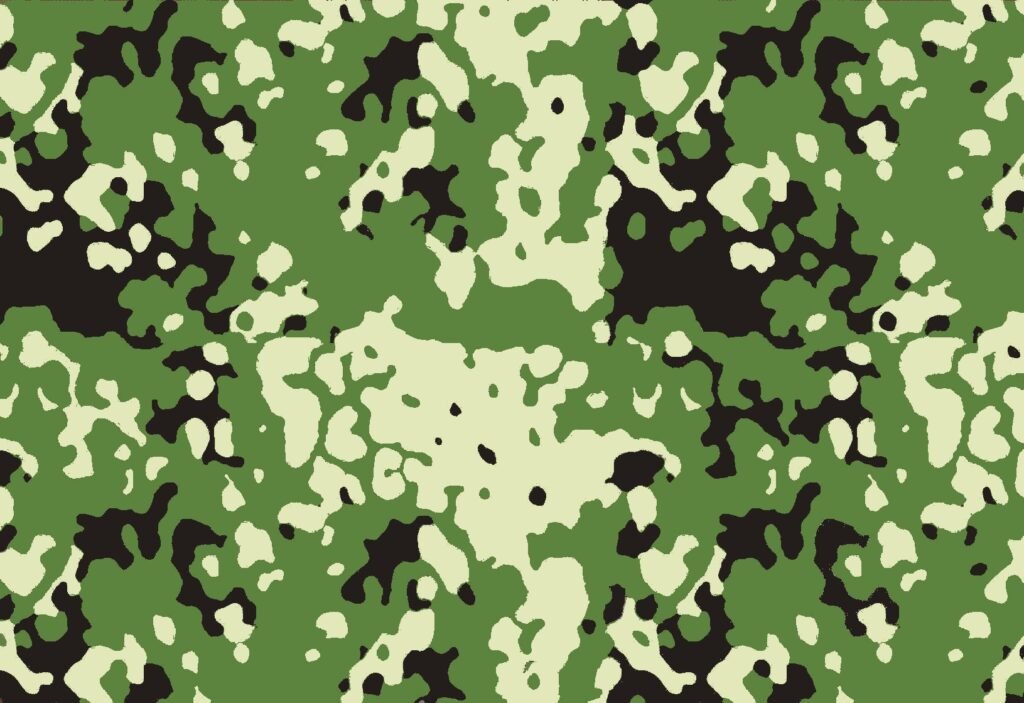
Flectar-D is Russia’s three colour version of the Danish M84 fleck pattern: black and sand coloured clumps and dots on a grass green field, introduced in 2006, made by Russian firms and taken up above all by the Airborne Troops. The D stands for Denmark.
| Country | Russia |
|---|---|
| Pattern type | Three colour fleck pattern |
| In use | From 2006 |
| Status | In use; produced commercially by more than one Russian maker, in more than one version |
| Colours | Black and sand coloured flecks and clumps on a grass green field |
| Used by | Russian Airborne Troops (VDV); also some special operations units |
Design
The design is the Danish Pletsløring geometry redrawn in three colours. The archived Kamouflage.net page specifies the 1990 variant of the Danish pattern as the basis and notes that Flectar-D uses considerably less black than its model. Camopedia describes the colours as black and sand coloured spotty clumps on a grass green field; the archived data lists the same three colours as black, grass green and tan. The name is only the best known of several: Camopedia records the pattern as also called Ryaska (duckweed), Sever (north) and Tochka (dots). A close relative, Tochka-4, adds a sparse brown element to the same design. Flectar without the D is a different Russian pattern, a copy of German flecktarn in black, dark green, greyish olive and russet on a yellowish tan ground, and the two names are often confused.
History
Post-Soviet Russia built a large commercial camouflage industry alongside its issued patterns, and units and individual soldiers bought widely from it. Flectar-D appeared in 2006, a local production of the Danish design that the German firm behind the Danish pattern had derived from Flecktarn B. It became popular among the Airborne Troops, the VDV, whose scouts are the users in the archived page’s photograph, and Camopedia adds use by some special operations units. Wikipedia’s flecktarn survey notes the pattern is made locally for military contractors, naming SPLAV among the makers. Because several companies produce it, print quality and exact shades vary, and there is no single specification behind the name.
Identification notes
Against the Danish M84 itself: the geometry is deliberately the same family, and Flectar-D’s reduced black and sand toned balance are matters of degree, so provenance, garment labels and Russian makers are the practical separators; an unlabelled swatch may not be separable from the Danish print with confidence. The Danish pages in this database are the desert colourways, T/99 Ørken and M/01 Ørken, whose pale desert palettes separate them from Flectar-D at a glance. Against German Flecktarn: the German pattern has five colours including a rust brown, on a light green ground, where Flectar-D has three and no rust. Against Tochka-4: any brown in the print points to Tochka-4, since standard Flectar-D has none.
Related patterns: Flecktarn B (Groß), Danish T/99 Ørken Camouflage, Danish M/01 Ørken Camouflage.
Swatch image: Flectar-D, drawn by Skjoldbro, CC BY-SA 4.0, via Wikimedia Commons.