
Les, Russian for forest, is the commercial woodland pattern of 1990s Russia: a four colour near copy of U.S. Woodland in black, brown and green on a pale sand ground, never officially issued and everywhere anyway, bought by internal troops, spetsnaz and ordinary soldiers out of their own pockets.
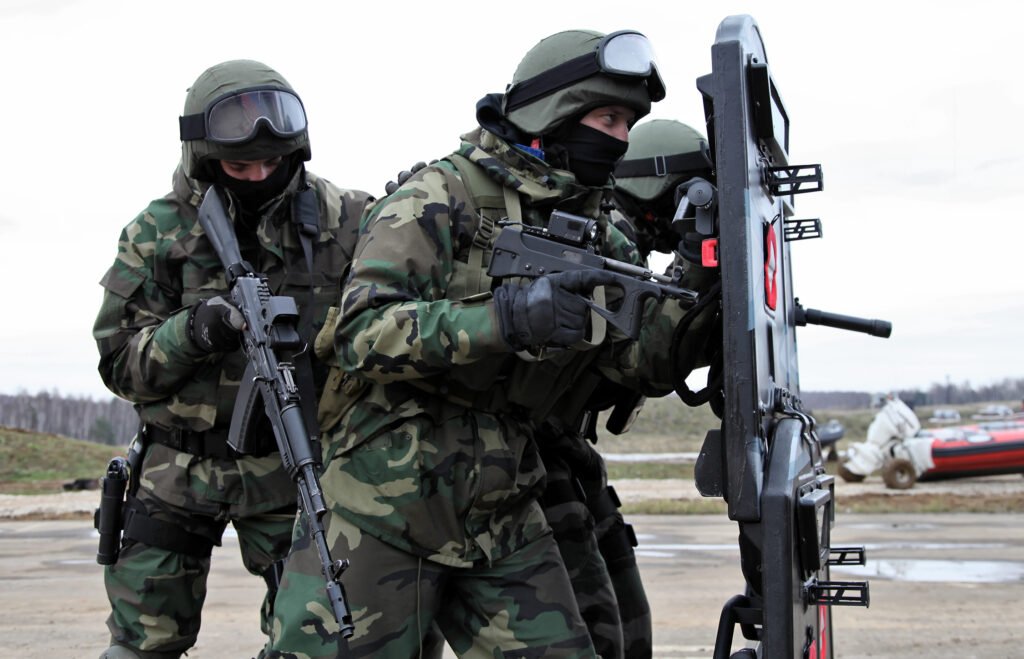
| Country | Russia |
|---|---|
| Pattern type | Four colour woodland derivative (commercial) |
| In use | From 1992, widespread through the 1990s and 2000s |
| Status | Commercial pattern; current production is not verified |
| Colours | Black, earth brown and medium green on a sand ground |
| Used by | MVD Internal Troops, GRU spetsnaz, and individual soldiers of the Armed Forces as private purchase |
Design
Les follows the U.S. Woodland design closely: the same blotchy four colour geometry in all directions, no pixels, no splinters, no leaf shapes. Its own character is in the palette and the provenance. The archived Kamouflage.net data, the only colour by colour source, gives black, earth brown and medium green elements on a sand coloured ground, a paler ground than the American pattern’s. Because Les was a commercial print made by numerous firms, there is no specification for any maker to conform to, and shade variation between makers is to be expected. Garments in the print include BDU style suits and commercial patrol suits from makers such as Splav; the Leshy sniper oversuit is sewn in Les cloth. Sellers also document an urban colourway of the same design in blue greys, called Gorod or urban Les; that is a seller documented relative, recorded here as such, and it is not the green pattern of this page.
History
After the Soviet collapse, Russia’s issued patterns were widely supplemented by private purchase, and commercial makers offered woodland style uniforms to soldiers whose units could not supply enough. Les is the commercial woodland name that stuck, in use from 1992. Its principal user was the Ministry of Internal Affairs, above all the Internal Troops, with GRU spetsnaz use alongside, and individual regular soldiers wore it in place of the issued Flora. The archived page is explicit about why: the predominance of the MVD and of private purchase was financial, not an official restriction, since most commercial uniforms were sponsor provided or bought by soldiers themselves. Wikipedia’s survey of U.S. Woodland copies lists Les, citing the standard references, among the Russian near copies worn by MVD agencies, and illustrates it with a photograph of Internal Troops wearing it.
Identification notes
Against U.S. Woodland itself, the pattern Les copies: separation rests on palette and provenance rather than geometry. Points toward Les are the paler sand ground of the archived palette, Russian commercial garment cuts and maker labels, and Russian users and insignia in photographs. The honest limit, stated plainly: from an unlabelled swatch alone, Les, the other Russian near copy KKO, and the true woodland copies may not be separable with confidence. Against Flora, the state issue pattern Les supplemented: Flora’s shapes are smooth, elongated and run horizontally, where Les follows the blotchy woodland geometry in all directions, and their status separates them too, since Flora was issued and Les was bought. A blue or grey version of this design is the urban Gorod colourway, not the green Les.
Related patterns: U.S. Woodland Pattern, M81, Russian Digital Flora (EMR) Camouflage.
Image: Russian Internal Troops wearing Les, photographed by Vitaly V. Kuzmin, CC BY-SA 4.0, via Wikimedia Commons. The photograph shows the pattern in wear; no flat swatch of Les is freely licensed. The identification follows the caption in Wikipedia’s U.S. Woodland article and the archived Kamouflage.net user data, which agree.