
Duby, Czech for oaks, is the Leibermuster style face of the Czechoslovak sniper and scout oversuit of the 1950s: black, green and red fingered shapes on a light ground, printed on one side of a reversible suit whose other face carries the soft mraky clouds print.
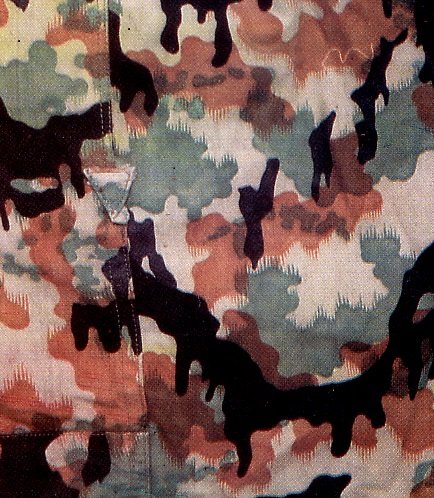
| Country | Czechoslovakia |
|---|---|
| Pattern type | Leibermuster-derived disruptive pattern |
| Produced | 1950s; production ended in 1962 |
| Status | Out of service (suits remained in use, many converted to work clothing, into the 1970s) |
| Colours | Black, medium green and red shapes on a light tan ground |
| Used by | Czechoslovak airborne troops, scouts and snipers, including the 22nd Airborne Brigade |
| Worn on | Reversible two piece oversuit (smock and trousers); Duby is one face, mraky the other |
Design
The print is a close relative of the German Leibermuster of 1945: amoeba like elements in black, green and red on a pale ground, the green and red shapes carrying the small finger like projections that mark the family. One specialist description calls the red transparent, an effect of the printing rather than a separate colour. The garment matters as much as the print. Following the Soviet oversuit idea, Czechoslovakia issued its scouts and snipers an oversized pullover suit worn over the field uniform, with an attached hood and face veil, integrated mittens and foliage loops. The suit is reversible: one face carries mraky, a soft two colour clouds print, and one version of the suit carries Duby on its other face. The ICUS index raises the possibility that the pattern was printed locally using original German rollers; that is a possibility raised by one source, not an established fact.
History
Czechoslovakia adopted the oversuit system in the mid 1950s, but where the Soviet model used Soviet prints, the Czechoslovak faces were home grown, the autumn face drawing on the German Leibermuster. The archived Kamouflage.net data gives the span 1954 to 1962; the 1954 start rests on that source alone, while the end is firmer, with production stopping in 1962 and the vz.60 mlok reaching the 22nd Airborne Brigade from 1960. After service, many suits were officially converted into work clothing, hoods and mittens removed and collars and cuffs added, and most surviving examples are these conversions. The red elements prompted a claim that Duby inspired the Swiss Leibermuster of 1955; the dates make it just possible, but no source checked establishes it, and this page records it as a claim only.
Identification notes
Against the German Leibermuster 1945: no clean print separator exists and none should be invented, since the Czechoslovak print was copied from it. The evidence is the garment. Duby exists only as one face of the Czechoslovak reversible oversuit, with a mraky clouds print on the other face and Czechoslovak construction and stamps; a single sided garment in this print points to the German pattern or a reproduction. Against the Swiss Leibermuster, with which Duby garments are sometimes confused: the Swiss print is worn on Swiss garments, ponchos and the TAZ uniforms, and again the garment and its markings decide. Against mraky, the other face of the same suit: mraky is soft cloud like blotches in two colours, while the face with black and red in it is Duby.
Related patterns: SS-Leibermuster (Leibermuster 1945), Czechoslovak Mlok Pattern (vz.60).
Image: the German Leibermuster of 1945, the pattern Duby derives from, by Joan Rocaguinard, CC BY-SA 3.0, via Wikimedia Commons. No freely licensed image of Duby itself is available.