
The M/62 was Finland’s first camouflage pattern, and one of the first camouflage uniforms issued across a whole army: large dark whorls on a light green ground, printed on lightweight cotton uniforms that mostly reversed to plain white for snow. Its nickname, kurkkusalaatti, passed to the M/91 that reprinted it.
| Country | Finland |
|---|---|
| Pattern type | Three colour spot (whorl) pattern |
| Introduced | 1962 |
| Status | Succeeded as the standard system by the M/91 from 1991; garments remained in use into the 2000s |
| Colours | Dark green and reddish brown whorls on a light green ground (the brown is described as maroon in the original Kamouflage.net data) |
| Used by | Finnish Defence Forces |
| Worn on | Lightweight cotton field uniform, most garments reversible to solid white |
Design
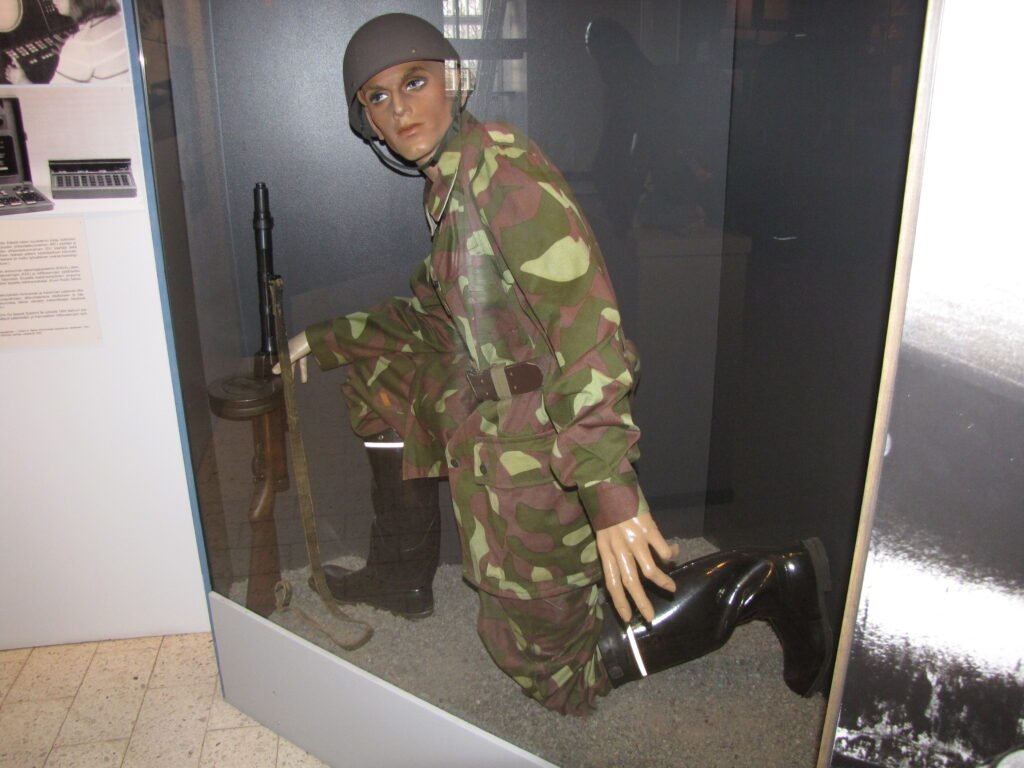
The print is built from large, irregular spots and whorls in two dark colours over a light green ground, the structure that earned it the kurkkusalaatti name, rendered in English as cucumber relish or cucumber salad. The second colour is a reddish brown: the original Kamouflage.net data calls it maroon, other descriptions call it dark brown, and the disagreement is about the same printed colour. What defines M62 cloth in practice is its inconsistency. Production ran across many makers and print runs with wide variation, lighter and darker sets are common, and some accounts suggest deliberate seasonal printings, which has never been officially confirmed. The uniforms themselves were lightweight cotton, jacket and trousers, most of them reversible to solid white, which made the camouflage uniform its own snow uniform.
History
Finland introduced the M62 in 1962, early for a general issue camouflage uniform. The archived Kamouflage.net data records the design’s influence as the Italian three colour camouflage of the telo mimetico family; that claim rests on the archived data and is stated here as its record, not as independently established. The pattern served as the Finnish standard for three decades. In 1991 its own print was reprinted in changed, standardised colours on the redesigned M/91 uniform system, which succeeded it as the standard; the archived span of 1962 to 1991 marks that succession, not the end of M62 wear, since garments stayed in use into the 2000s, including a niche use with the Utti Jaeger Regiment. The M05 family replaced the whole system from about 2007. No formal withdrawal date for the M62 has been verified.
Identification notes
Against the M/91, the honest answer is that the print alone may not separate them: the spot artwork is essentially the same design, reprinted. Colour consistency is a pointer, since a very pale, very dark or strongly mismatched set points toward M62 and consistent colouring points toward M91, but it is not proof. The reliable separator is the garment: M62 uniforms are the lightweight reversible cotton of the earlier period, most reversible to solid white, while M91 garments belong to the redesigned early 1990s uniform system. Check the white reverse, the cut, the labels and the date; from a small swatch with none of those visible, M62 and M91 may not be separable with confidence. Against M05 woodland the separation is clear: M62 has three colours and large whorls, M05 has four colours including a charcoal shadow tone and smaller lichen like patches.
Related patterns: Finnish M/91 Camouflage Pattern, Finnish M05 Woodland Pattern.
Image: a Finnish coastal artillery private in the m/62 uniform, by MKFI, public domain, via Wikimedia Commons. The photograph shows the pattern in wear; no flat swatch of the M62 print is freely licensed.