
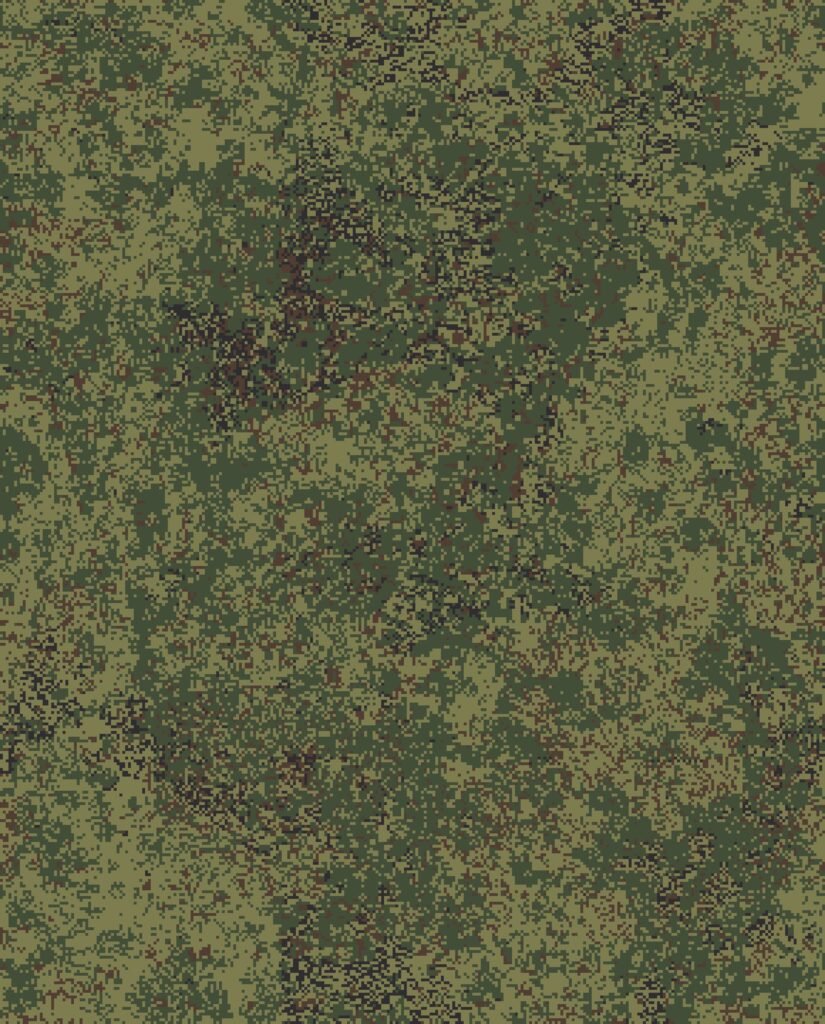
Digital Flora, officially the EMR, is the Russian armed forces’ universal digital pattern: tiny square pixels in the old Flora colours, grouped so that at any distance beyond a few metres they merge into soft blotches. It has been the standard pattern of the Russian field uniform since 2011.
| Country | Russia |
|---|---|
| Pattern type | Digital (micro-pixel), universal pattern family |
| Introduced | Designed 2008, full scale adoption from 2011 |
| Status | In service, alongside newer MultiCam style patterns in the latest uniform kits |
| Colours | Dark green, brown and black pixels on a pale green ground (standard summer version) |
| Used by | Russian Armed Forces; also adopted by Belarus and Tajikistan |
Design
The official name is Edinaya maskirovochnaya rastsvetka, EMR, meaning a single camouflage colouring for all branches, recoloured for each environment. In the West it is called Digital Flora, RUSPAT or Tsifra. The construction follows the logic of German flecktarn, which the sources state openly: the smallest spots do the close range work, and the same spots cluster into large groups that break up the outline at distance. Here the building element is an extremely small square pixel, so the standard summer version, Leto, reads up close as a busy field of pale green, dark green, brown and black pixels and at range as soft organic shapes in the colours of the Flora pattern it replaced. The same geometry is printed in other palettes: a white and greys northern version, a sand and beige desert version reported in Syria from 2016, and an urban version whose colours are not authoritatively listed. Variant naming in the sources is untidy, with Sever, Arctic and Zima overlapping, and shade differences between manufacturers are common and are not by themselves named variants.
History
The EMR was designed in 2008 at the 15th Central Research Institute of the Russian Ministry of Defence, as the American move from woodland to digital patterns made the 1998 Flora look dated. On 28 January 2008 President Putin inspected models of the new uniforms at the Defence Ministry with Defence Minister Serdyukov, the anchor date for the pattern’s public debut. It was accepted for supply in 2009 and replaced Flora at full scale from 2011, becoming the centre of the layered VKPO uniform system and the main pattern of the Ratnik infantry programme; an early version is the print in the 2014 Crimea photographs. Belarus adopted it as its standard pattern and Tajikistan followed. Its position is now one of transition rather than sole standard: the VKPO 3.0 kits shipped from 2023 have been produced in both Tsifra and a Russian MultiCam style pattern, so both prints are current Russian issue.
Identification notes
Start with the pixels: if a Russian pattern has no square pixels, it is not EMR. Against Flora, which EMR replaced and whose colours it keeps: Flora’s shapes are smooth, elongated and run horizontally, while EMR is tiny pixels clustering in all directions with no stripe direction; colour does not separate them, shape does. Against the Soviet KLMK: that is a two colour pattern of jagged leaf shaped spots on a darker ground, where EMR is four colours of square pixels on a pale ground. Against SURPAT, the commercial special forces pattern adapted from MARPAT: SURPAT sits on a light grey base, EMR’s standard base is pale green. A VKPO 3.0 cut uniform is not automatically EMR, since the same kit was shipped in a MultiCam style print; check the print, not the garment.
Related patterns: Soviet KLMK Pattern, Obverse (‘Solnechnyye Zaychiki’), Russian Partizan Pattern (Autumn, Bright).
Swatch image: standard summer EMR, by Grieferus, CC0, via Wikimedia Commons.