
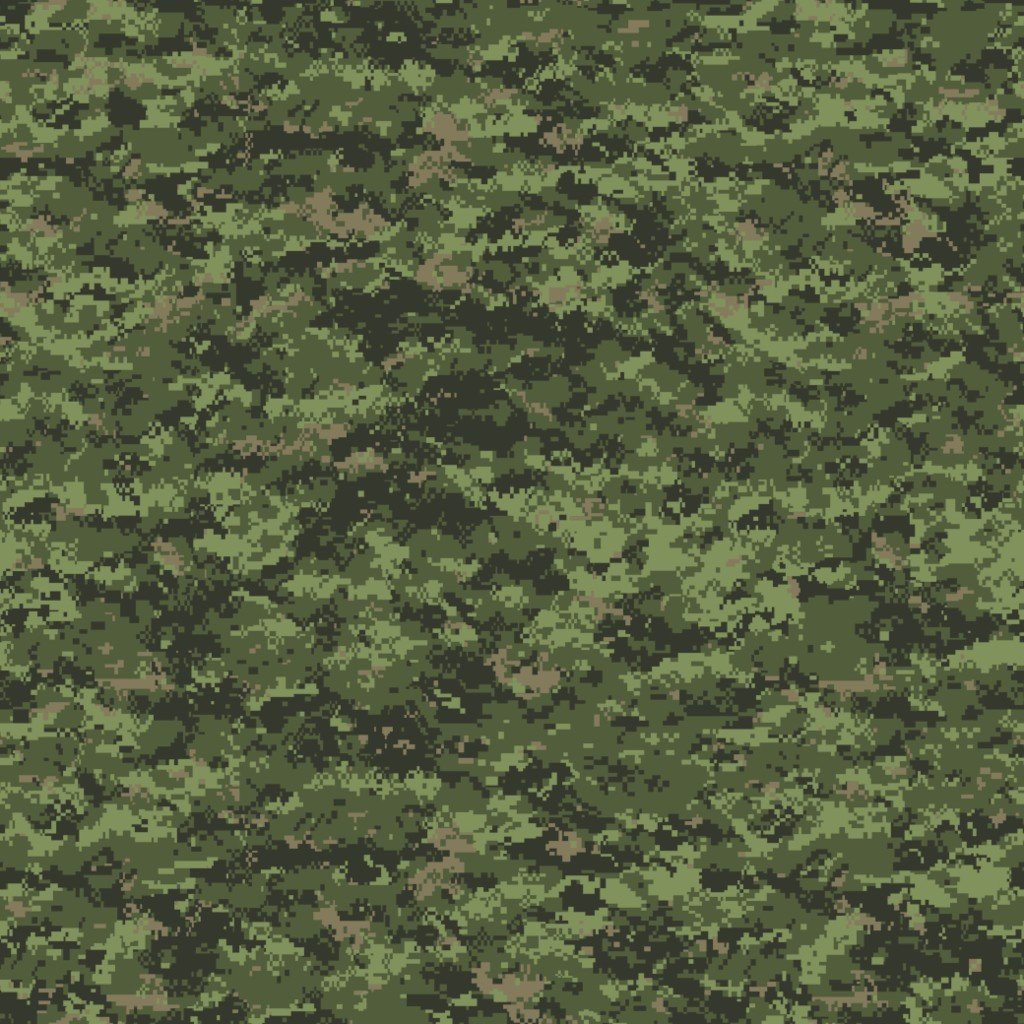
CADPAT (TW) is Canada’s temperate woodland pattern: a four colour digital design of pixel clusters with softened, dithered edges, and the first computer generated camouflage pattern to enter general service anywhere. It became the standard Canadian combat uniform pattern in 2002 and is now being replaced by the multi-terrain member of its own family.
| Country | Canada |
|---|---|
| Pattern type | Four colour digital (pixelated) woodland pattern |
| In use | First appeared in the late 1990s; standard issue from 2002; replacement by CADPAT (MT) began in 2024 |
| Status | Being phased out in favour of CADPAT (MT) over the mid-2020s |
| Colours | Four: light green, dark green, brown and black |
| Used by | Canadian Armed Forces; Land Force Command from 2002, Air Command from 2004 |
Design
CADPAT is built from small square pixel clusters rather than drawn shapes. Where the colour areas meet, the pixels are digitally aliased, a dithering effect that softens the boundary between one colour and the next, so at distance the blocks blend and the wearer’s outline goes fuzzy. Canadian defence research describes the pattern as working best at 30 to 350 metres against a three power optical sight. The inks also carry near infrared protection, so the pattern keeps working against night vision devices. The temperate woodland version, TW, runs in light green, dark green, brown and black, a brighter and greener palette than most digital patterns of its generation. CADPAT is a trademark of the Department of National Defence, registered in February 2002.
History
The pattern was developed under the Clothe the Soldier programme, the Canadian project to replace the whole combat clothing system. Canada.ca records that the seed of the design was planted in Denmark, and the CADPAT patent literature cites Timothy O’Neill’s 1970s Dual-Tex research as an early inspiration. The claim often made for CADPAT, that it was the first computer designed camouflage put into service, holds with one qualifier: the American Dual-Tex was computer based too, but experimental and never generally issued, so CADPAT (TW) stands as the first computer generated pattern to enter general service. Sources disagree on the exact first appearance: 1995, 1996 and 1997/98 all appear in print, attached to helmet covers and camouflage nets, so this page dates the debut to the late 1990s and leaves the spread standing. The first operational use of the TW uniform came in September 2001 in Bosnia-Herzegovina, on Operation Palladium. Issue at home followed quickly: the Army’s February 2002 backgrounder records about a third of the Army already wearing it by January 2002, with full conversion expected by the end of that year, and Air Command followed in 2004. Period Canadian Army material reported strong trial results, including NATO soldiers rating CADPAT (TW) the best temperate pattern in studies and a figure of 40 per cent greater effectiveness than the olive drab uniform it replaced at ranges up to 200 metres; those figures rest on the Army’s own reporting of the time and are given here as reported results, not verified measurements. The family grew around the TW original: an Arid Regions version in three browns, issued from the summer of 2002 for Afghanistan, and a Winter Operations version. In 2021 Canada selected CADPAT (MT), a multi-terrain member of the family, to replace both TW and AR; issue began in February 2024, and the changeover runs through the mid-2020s.
Identification notes
Against MARPAT, the other North American digital pattern: CADPAT (TW) is brighter and greener overall and carries no insignia in the print, while MARPAT runs darker and browner and prints the Marine Corps Eagle, Globe and Anchor into the pattern itself. Against the Danish M84 and the Flecktarn family: those are built from small rounded flecks, while CADPAT is square pixel clusters with dithered edges. Against its own arid sibling, CADPAT (AR) has only three shades of brown. Against the American UCP: that is a grey dominant three colour design with no black and no brown in it.
Related patterns: Woodland MARPAT Pattern (USMC Digital Camouflage), Russian Digital Flora (EMR) Camouflage.
Image: the official CADPAT (TW) swatch, Government of Canada, public domain, via Wikimedia Commons.