
The T/99 Ørken was Denmark’s first desert camouflage. Trialled in 1999 and issued in 2000, it is the Danish M/84 spot pattern recoloured for arid ground, and it was the direct starting point for the M/01 desert uniform that followed it.
| Country | Denmark |
|---|---|
| Pattern type | Three colour desert spot pattern |
| Developed | Trialled 1999, issued 2000 |
| Status | Obsolete, developed into the M/01 in 2001 |
| Colours | Sand, earthy red, dark green |
| Used by | Danish Armed Forces, first issued for the UN mission in Ethiopia and Eritrea |
Design
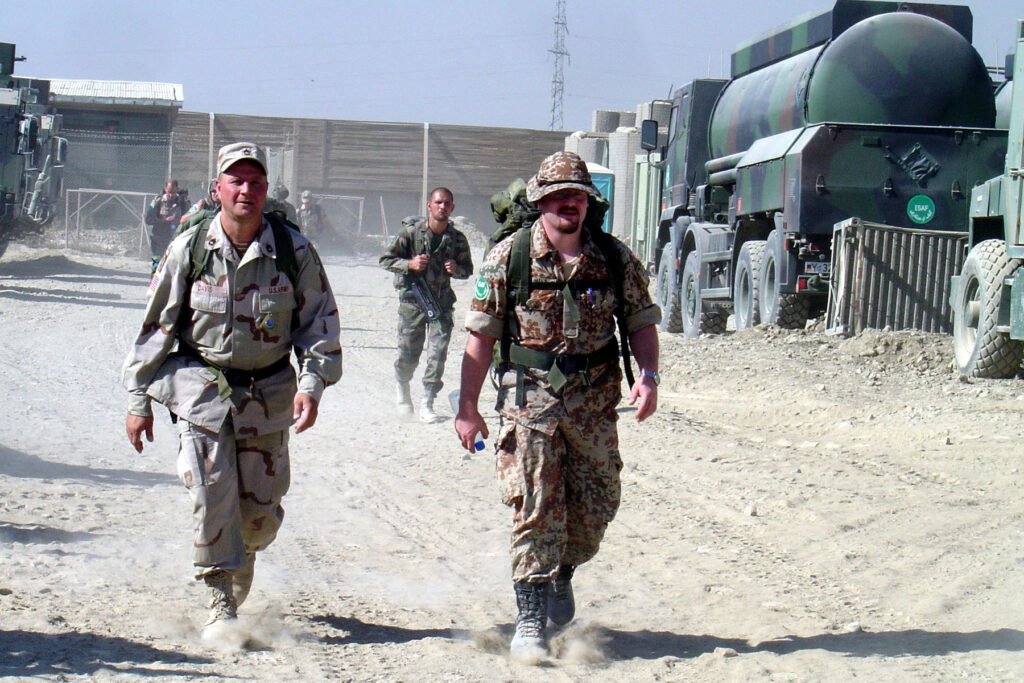
The T/99 is a straight recolouring of the M/84 Pletsløring. The spot shapes are the standard M/84 shapes, printed in three desert colours: earthy red where the woodland pattern has black, dark green where it has light green, and a sand colour in place of the olive green ground. The result keeps the soft edged, dithered look of the M/84 while shifting the whole pattern into the browns and tans of dry terrain.
History
Denmark created the T/99 when its troops needed a desert uniform for the UN Standby High Readiness Brigade, SHIRBRIG, and its first issue was to Danish personnel serving with the UN mission in Ethiopia and Eritrea in 2000. A persistent rumour holds that the pattern is a modified German desert Flecktarn, but the references are clear that it is the Danish M/84 recoloured. In 2001 the pattern was researched and improved, and the result entered service as the Kampuniform M/01 Ørken, first seen with the Danish ISAF contingent in Afghanistan. The two designations blur together in some Danish equipment listings, which describe the later M/01 uniform as using T/99 camouflage.
Identification notes
Date and deployment are the most reliable guides. A Danish desert uniform from the 1999 to 2000 Ethiopia and Eritrea deployment is the T/99; the lightweight ripstop desert uniforms of the Afghanistan years are generally the M/01 refinement. The sources do not document a firm visual difference between the two prints, and they should not be separated on print details alone. Against other desert patterns, the large rounded M/84 spots in sand, earthy red and dark green are the giveaway, quite different from the smaller, denser flecks of the German Tropentarn.
Related patterns: Danish Kampuniform M/01 Ørken, German Flecktarn.
Photo: U.S. Army photo by Col. Randy Pullen, public domain, via Wikimedia Commons. The Danish soldier on the right wears the Danish desert pattern in Afghanistan in 2004, beside a U.S. soldier in the three colour desert pattern.