
The Bundeswehr-Leibermuster is not the famous 1945 pattern itself but its post-war afterlife: a six colour Leibermuster print made in Belgium in the mid-1950s for the soldiers of the newly formed Bundeswehr, under the short-lived plan for a common European army. Every surviving uniform is stamped with Belgian army markings, which misled collectors for years.
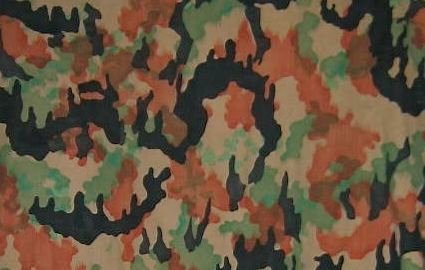
| Country | Federal Republic of Germany (West Germany) |
|---|---|
| Pattern type | Six colour Leibermuster derivative |
| In use | 1955–1958 (archived Kamouflage.net data) |
| Status | Trial and limited issue only; never fully implemented |
| Colours | Tan background, white flecks overprinted with very light green, feathered medium green and brick-red swathes, black branch shapes |
| Used by | Bundeswehr (Heer); Bundesgrenzschutz (archived data) |
Design
The print is the 1945 Leibermuster design carried into a new army. The archived Kamouflage.net page describes it layer by layer: a tan background; white flecks overprinted with a very light green; an overprint of feathered, leaf-shaped swathes in medium green and brick red; and finally black branch shapes on top. Six colours in all, the same construction as its wartime parent. Camopedia adds the practical detail that the wartime printing screens had been retained, so the post-war cloth could be printed from the original Leibermuster artwork rather than from a copy. What makes the pattern identifiable is not the print but the clothing. Every surviving uniform was made in Belgium and is prominently stamped ABL, for Armée Belge, Belgische Leger, Belgian Army in French and Dutch. Those stamps gave the pattern its other name, Belgian Leibermuster, and persuaded many collectors that it was a Belgian pattern that Germany never used. The photographs say otherwise.
History
The archived page sets out the evidence carefully. Photographs from the mid to late 1950s show the uniforms being worn only by soldiers of the newly formed Bundeswehr, one of them armed with a Belgian FN FAL rifle. Daniel Peterson, author of the standard book on SS camouflage and its post-war derivatives, interviewed Belgian veterans who had no recollection of the pattern ever being used by their own army, even on trial, and his conclusion that the uniforms were produced exclusively for the Bundeswehr is supported by at least one indisputably German Zeltbahn printed in the pattern. Dan Feldkamp, the specialist in early Bundeswehr uniforms, supplies the reason for the Belgian manufacture: the pattern was developed under the early plans for a European Defense Force, whose member nations divided equipment production between them. Belgian uniform makers drew the job of producing uniforms for the German army, and marked their work accordingly. Camopedia tells the same story in shorter form: the Leibermuster screens were considered in the 1950s for a universal camouflage for Germany, Belgium and the Netherlands, and limited quantities were tested by the Bundeswehr in 1955–56. The pattern was short-lived, and nobody knows exactly why. The archived page lists the speculations without choosing between them: that the design’s close association with the Waffen-SS carried memories the new army did not want; Peterson’s suggestion that the Bundeswehr wanted to look visibly different from the Czechoslovak and Swiss armies, which had adopted similar Leibermuster derivatives at the same time; and the simplest explanation, that France’s withdrawal killed the European Defense Force and the pattern died with the project. The name of this page follows the archived original: this is a Bundeswehr pattern of 1955–1958, not a wartime one, and the 1945 SS-Leibermuster has its own page in this database.
Identification notes
Against the 1945 Leibermuster itself: the print is deliberately near identical, so the garment is the separator. Belgian manufacture, ABL stamps and 1950s West German uniform cuts point to the Bundeswehr version; wartime SS garments point to 1945. Against the Swiss Leibermuster 1955, the Alpenflage: Switzerland adopted its own Leibermuster derivative at almost exactly the same time, heavier and redder in effect, and worn on Swiss uniform cuts with Swiss markings. Against the Czechoslovak Duby: Duby is a Leibermuster derivative printed as one face of a reversible Czech oversuit, so a two-faced garment with a different print on the reverse is Czech, not German. Peterson’s point stands as the practical rule for the whole family: with the print shared, labels, stamps and provenance are what separate these patterns, and an unmarked loose piece of Leibermuster cloth from the 1950s cannot always be assigned to one army with confidence.
Related patterns: SS-Leibermuster (Leibermuster 1945), Swiss Leibermuster 1955 (Alpenflage), Czechoslovak Duby Camouflage Pattern.
Swatch image: Bundeswehr-Leibermuster, by Joan Rocaguinard, CC BY-SA 4.0, via Wikimedia Commons.