
The ‘Somalia’ pattern is the Italian woodland design redrawn in desert colours: a four colour scheme of pale browns and greyish olive on a sandy ground, made for Italy’s peacekeeping deployments of the 1990s and named for the Somalia mission where it was worn most famously.
| Country | Italy |
|---|---|
| Pattern type | Four colour desert pattern |
| In use | Sources disagree: 1993–2004 in the archived Kamouflage.net data; introduced early in 1991 per Camopedia |
| Status | Replaced as the standard Italian desert pattern by a new four colour desert design in 2004 (archived data) |
| Colours | Reddish and yellowish browns, greyish olive and a sandy ground (see Design) |
| Used by | Italian Army (Esercito Italiano) |
Design
The shapes are the Italian woodland pattern’s, unchanged; only the colours moved. The archived Kamouflage.net page gives the substitution colour by colour: light yellowish brown in place of the woodland’s dark greyish yellowish brown, light brown in place of dark greyish olive, greyish olive in place of greyish yellowish brown, and greyish reddish brown in place of black. Camopedia describes the same result more shortly as reddish-brown, olive green and beige woodland-type shapes on a sandy background. Both accounts agree on the essential point, that this is the woodland design in a desert palette, and the archived page’s colour mapping is the more detailed record. The nickname differs between sources too: the archived page calls the pattern ‘Somalia’, while Camopedia says it earned the name Mogadiscio, after Mogadishu, during the Somalia deployment.
History
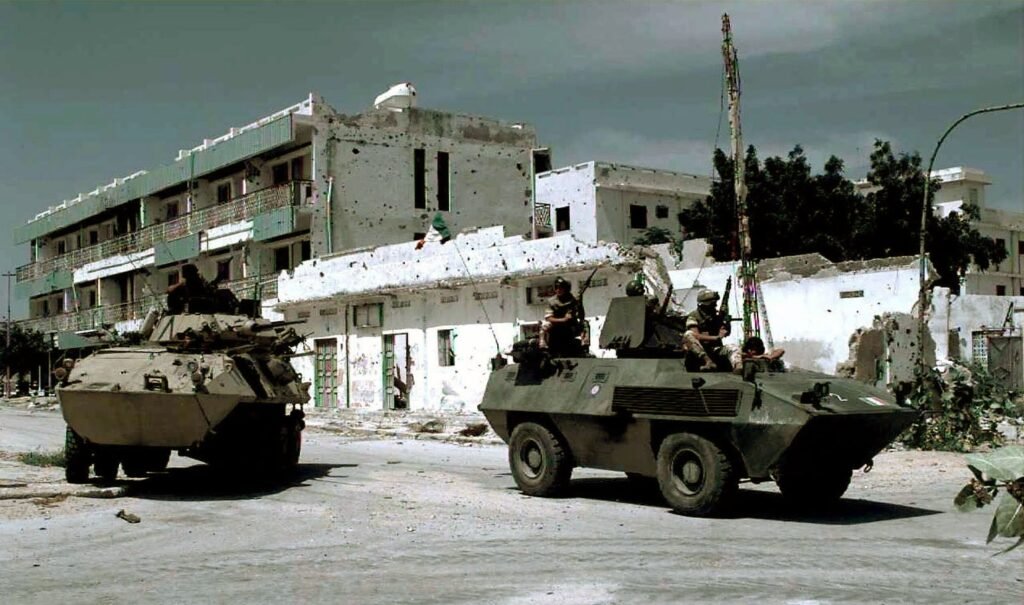
Italy became an active peacekeeping contributor in the last decade of the twentieth century, and desert deployments needed a desert uniform. Here the sources part company on dates, and the disagreement is recorded rather than resolved. The archived page says the pattern was issued when Italy contributed troops to UNOSOM II in Somalia in 1993, and that it remained the standard Italian desert pattern until 2004, when a new Italian four colour desert camouflage replaced it. Camopedia dates the introduction earlier, to early 1991, says it was first worn by Italian soldiers in Kurdistan during Operation Provide Comfort, and describes it as the standard Army desert pattern for the next fifteen years, which points to about 2005 or 2006. The archived page’s own photograph caption also calls it the 1991 pattern. What is not in dispute is the service: Italian troops wore it in Somalia in 1993, where Italian soldiers were photographed in Mogadishu that January, and it stayed in use into the Iraq and Afghanistan years before the Vegetata family took over.
Identification notes
Against the Italian woodland pattern it derives from: the drawings are the same, so the palette decides; woodland greens and dark browns mean the temperate pattern, pale sandy tones with reddish brown mean this one. Against the American Three Color Desert Pattern, its contemporary: the American print has three colours of smooth wavy shapes, while the Italian has four colours of woodland shapes including a distinct reddish brown. Against its 2004 successor, the later Italian four colour desert: the two are close in idea, and separation rests on the exact palette and on garment contract dates rather than on shape, since both keep woodland-type geometry. Against the telo mimetico family it is sometimes confused with in surplus listings: the telo shapes are amoeba-like and much older, and no telo print uses this pale desert palette.
Related patterns: Italian M29 Telo Mimetico Camouflage, Second Pattern, Three Color Desert Pattern.
Image: Italian soldiers crewing a Fiat-Oto Melara 6614 armoured personnel carrier on the Green Line in Mogadishu, 19 January 1993, photographed by PH1 R. Oriez, US Navy, public domain, via Wikimedia Commons. The photograph documents the Somalia deployment the pattern is named for; the desert uniform is worn in frame but the print itself is not clearly readable at this size.