
The Sumpfmuster 43, known to collectors as Tan and Water, was the Wehrmacht’s marsh pattern: the hard geometry of the 1931 splinter design softened, enlarged and reversed in emphasis, printed for smocks, parkas and field jackets from 1943 until the end of the war.
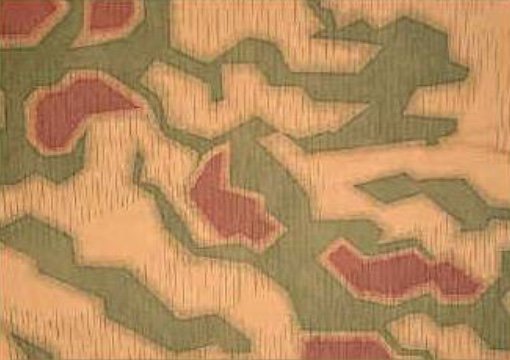
| Country | Germany |
|---|---|
| Pattern type | Splinter-derived marsh pattern with rain stroke overprint |
| Introduced | First issued late 1942 or early 1943 |
| Status | Out of service (1945) |
| Colours | Medium green and brown shapes on a tan ground, with dark green rain strokes overprinted (no official colour specification exists and surviving pieces vary) |
| Used by | Wehrmacht, principally the Army (Heer) and the Luftwaffe including paratroopers |
Design
The pattern descends directly from the Splittermuster 31: angular polygons in green and brown on a light ground, with the green rain dashes carried over as an overprint. Three changes mark the development. The shapes are enlarged and more open. The colour balance is reversed, so green rather than the ground tone dominates. And the edges are burred, softened so the shapes dissolve into the ground instead of ending in the splinter pattern’s hard lines. In the 43 print the green and brown shapes generally do not touch or overlap; a fine line of ground colour separates them. The brown is a single printed colour, called wood brown, russet or maroon by different writers. The pattern was roller printed by many factories, and surviving garments vary widely in shade through dye lots and fading. Whether it reads as hard edged or soft edged depends on the comparison: softened against the 1931 splinter, it is still clearly angular against its own successor of 1944.
History
The Wehrmacht issued camouflage clothing widely only from 1942, starting with the splinter pattern. The Sumpfmuster followed as the updated clothing pattern, first issued late in 1942 or early in 1943, and was made into more types of regulation garment than any other German pattern of the war: smocks, many of them reversible to white, reversible winter parkas, overtrousers, paratrooper jump smocks, field jackets and helmet covers among them. The shelter half stayed in the splinter print; Sumpfmuster was a clothing pattern. In 1944 it was partly superseded in production by the revised Sumpfmuster 44, but 43 garments stayed in use to May 1945. After the war the West German Bundesgrenzschutz revived the concept in three successive versions, and BGS cloth has since been used to fake wartime pieces, which is why the identification notes below matter. Claims in dealer listings that the pattern was a Waffen-SS issue are not supported by the standard references; its documented users are the Army and the Luftwaffe.
Identification notes
Against Sumpfmuster 44: colour does not separate them, since both use the same palette and the same rain overprint. Shape does. In the 43 the angular splinter polygons are still readable, with burred edges only; in the 44 the geometry is largely gone, replaced by rounded blotches bordered by blurred zones of small dots fading into the ground. Readable polygons mean 43; rounded blotches with a dot halo mean 44. Against the postwar BGS designs: any overlap between the russet and olive shapes rules out the wartime 43 and points to the BGS second or third designs; a blurred tan border around the russet patches with an unusually heavy rain overprint is the BGS third design alone. The BGS first design is the hard case, since its shapes do not overlap either, and references warn that telling it from wartime 43 can be genuinely difficult; postwar garment cuts, BGS insignia and construction details are then the deciding evidence. No wartime 43 garment was made after May 1945.
Related patterns: Reichswehr-Splittermuster 31, BGS Sumpfmuster, First Design, Bundesgrenzschutz Sumpfmuster, Third Design.
Image: Sumpfmuster 43 cloth, by ThePickleGambit, CC BY-SA 4.0, via Wikimedia Commons. The same swatch illustrates the Czechoslovak copy of this pattern elsewhere in the database.