
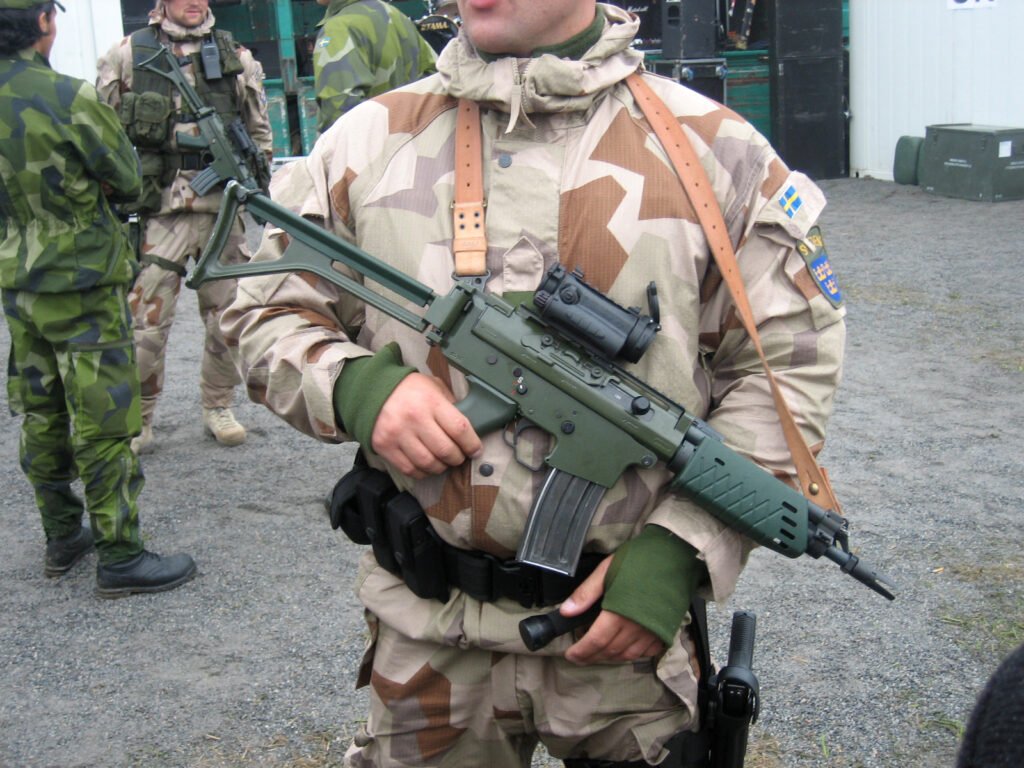
M90K, the ökenkamo or desert camouflage, is Sweden’s M90 splinter pattern in desert colours: the same oversized hard edged shards, printed in earth brown, light green and medium grey on sand. It was made for one job, Swedish troops serving in arid countries, and it has never been a general issue uniform at home.
| Country | Sweden |
|---|---|
| Pattern type | Four colour hard edged splinter pattern, desert colourway of M90 |
| Introduced | 2004, for the Swedish ISAF contingent in Afghanistan |
| Status | Current mission issue colourway for arid deployments |
| Colours | Earth brown, light green and medium grey splinters on a sand ground |
| Used by | Swedish Armed Forces personnel on arid deployments |
| Worn on | Desert colourway of the lightweight M90 uniform: field jacket, trousers, field cap, helmet cover |
Design
The desert variant keeps the M90 drawing exactly: the same very large, straight edged geometric splinters that abut one another with no curves, no dots and no rain strokes, scaled so the repeat fits across a human torso. Only the palette changes, and it changes within the same four colour structure. Where the woodland print puts dark green, medium green and a near black shadow colour over a light beige ground, the desert print puts earth brown, light green and medium grey splinters over a sand coloured ground: the pale ground stays pale, the dark shadow shapes soften to grey, and the brown becomes the darkest, warmest element. At any distance the garment reads as a pale tan uniform with angular grey green and brown shards, instantly recognisable as M90 but clearly not the woodland print. The uniform follows the lightweight M90L cut in a thinner khaki fabric than the standard M90 gabardine, made for extreme heat, and the desert system is described as including a smock because desert nights can be cold.
History
The M90 drawing descends from the FOA vehicle and aircraft splinter pattern of the 1970s, scaled down for uniforms in the 1980s, and Fältuniform 90 was formally established on 19 February 1990 in the woodland palette only. Sweden’s growing overseas commitments in the 1990s created a need the woodland uniform did not meet. The desert colourway was introduced in 2004 for the Swedish contingent serving with ISAF in Afghanistan, where Sweden ran the Provincial Reconstruction Team at Mazar-e Sharif. Issue stayed limited: a period review of the late 2000s describes M90K as still an experimental battle dress assigned only to Nordic Battle Group operators and to personnel serving in Afghanistan and other desert countries, which is period reporting rather than an official statement, but it fits the pattern’s mission issue character and the scarcity of genuine pieces. Photographs show it in service in 2006, at exercise Bold Quest in California in 2007, and during the King’s visit to the Swedish force in Afghanistan in 2011. Secondary pattern references and photography also place the desert uniform with the Swedish MINUSMA contingent in Mali from 2014 to 2015 onward; no Swedish Armed Forces source found for this page names the uniform for Mali, so that use is reported rather than officially confirmed. In October 2020 Sweden registered the updated, protected M90 design in three iterations, standard, khaki desert and winter, the change being small three crowns symbols scattered in the print, and photographs from 2021 show the desert colourway still worn. One naming problem runs through the sources: current Swedish uniform references give the desert colourway as M90 TR BE (Tropik Beige) with exactly the same colour description, and it is not clear from published sources whether TR BE is a successor system, a parallel tropic cut garment, or simply the current official name for the same colourway. This page keeps M90K, the established name from 2004, and records the overlap rather than drawing a hard line between the two designations.
Identification notes
Geometry first: if the shapes are the huge, straight edged M90 polygons, the garment is an M90 family print, and the palette then decides the variant. Against woodland M90: the desert print has no dark green and no near black shapes; its darkest shapes are earth brown, its mid tones are medium grey and light green, and the whole garment reads pale sand. A faded woodland uniform can look washed out but keeps its dark green and blackish shapes, which the desert print never had. The ground is sand to cream, lighter and warmer than the woodland print’s beige stone. Cut and fabric support the call: the desert uniform is the lightweight M90L pattern in thin khaki fabric, so a desert print garment in heavy standard fabric should be treated with suspicion. Against M90 TR BE there is no reliable visual separator in published descriptions; the tropic garments differ in construction details, and garment labels are the practical test. The pattern was unprotected until 2020 and commercial copies are common, so Swedish Armed Forces labels and correct lightweight construction matter more than the print alone. In group photographs from Afghanistan and Mali, Finnish desert dress (the m/04 hot weather uniform) appears alongside Swedish troops and has been confused with M90K in collector posts; the oversized angular shards separate the Swedish print.
Related patterns: Swedish M90 Camouflage, German Tropentarn.
Photograph: Shisha, CC BY 2.5, via Wikimedia Commons. A Swedish soldier in the M90 desert uniform aiming an Ak 5D rifle, May 2006.