
The red Auscam is Australia’s standard DPCU drawing printed in reds and browns instead of greens: a uniform for the enemy. Australian soldiers wore it in the opposing force role on exercises, playing the Musorian Armed Forces, the Australian Army’s fictional Soviet style enemy, so that troops could tell friend from foe at a glance. Collectors know it as the enemy cams, OPFOR DPCU or Musorian DPCU.
| Country | Australia |
|---|---|
| Pattern type | Spot (jelly bean) disruptive pattern, red colourway of DPCU |
| Introduced | Sources disagree, with dates from 1987 to the late 1990s claimed; most accounts place it in the 1990s |
| Status | Obsolete; officially out of service by the late 1990s on most accounts, with stocks worn into the 2000s |
| Colours | Reds, rust and browns on a tan ground, with no green |
| Used by | Australian Army opposing force (OPFOR) troops portraying the Musorian Armed Forces |
| Worn on | Shirt, trousers and kepi (flap) cap |
Design
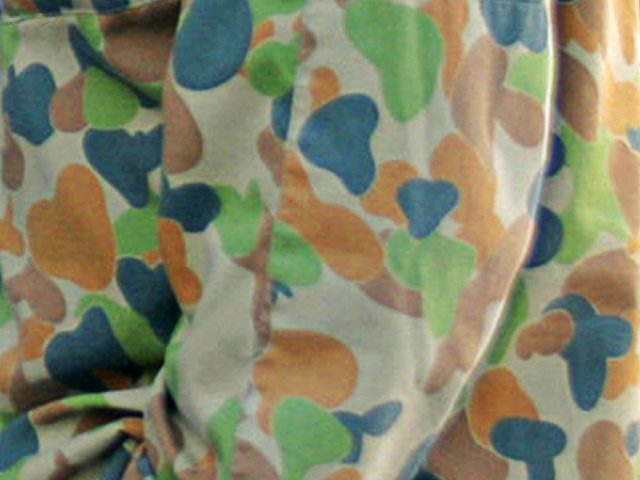
The drawing is standard DPCU with no change to the shapes: the same rounded, scattered jelly bean spots drawn from aerial photographs of Australian terrain. Only the palette changes. The two greens of the standard pattern are dropped and the whole print shifts into browns in three depths plus a strong red and a rust tone, printed on a tan ground in place of the standard greenish sand. The references do not agree on the count: Wikipedia lists four spot colours plus the ground, while Camopedia and the ICUS Camouflage Index list five spot colours, adding rust. Wikipedia says the result was supposedly meant to resemble a Russian style pattern, which fits its job of dressing a Soviet style fictional enemy, and notes the pattern was also found to be very effective in the red sands of the Australian desert. No webbing, packs or other equipment in the pattern are documented; the uniform is a shirt, trousers and the kepi flap cap.
History
The enemy came first. In 1980 the Australian Army formalised its fictional opposing force in a Manual of Land Warfare pamphlet, The Musorian Armed Forces, a Soviet doctrine enemy used throughout officer training. Standard DPCU entered general service at the end of the 1980s, and the red colourway followed for the troops who played Musoria in force on force exercises. When exactly is the pattern’s biggest open question: Camopedia dates its introduction to 1987, Wikipedia describes it as trialled in the early 1990s, the ICUS index gives about 1997 to 1998, and collectors describe a short production run in the early to mid 1990s. This page gives the range rather than one year, because the sources cannot all be right and standard DPCU itself was only trialled in 1987. From the mid 1990s a locally made copy of the U.S. three colour desert pattern began taking over the opposing force role. Wikipedia says supplies of the red pattern had dried up by 1995 and that it was officially taken out of service in 1998, yet collector posted photographs show Delta Company, 2RAR still wearing it on exercise in 2000, which is consistent with an official withdrawal followed by leftover stocks. Wikipedia also states, without a visible citation, that the pattern was briefly put back into production in 2007; two collectors independently report red shirts with different label dates and different pocket arrangements, which hints at more than one production run, but the 2007 run itself rests on that single source. No source found for this page ties the pattern to the Combat Training Centre or to any single exercise. Surviving sets are scarce and sought after, with one complete set reported sold for a little over 1,000 U.S. dollars.
Identification notes
The drawing is identical to standard DPCU, so the palette is the test: if the spot shapes match Auscam but the colours are reds, rust and browns on tan with no green anywhere, it is the red opposing force variant. A faded standard uniform is not the same thing; faded DPCU keeps green and orange brown tones and never shows the strong blood red spots. Garments are Australian issue style shirt, trousers and kepi cap with Australian maker labels, and the pattern was made in Australia. Collectors report two shirt variants, one with two chest pockets and one with a single chest pocket, with different dates on the labels; that is collector observation rather than documented fact, but it may point to two production runs. Against the desert variant, DPDU: that is a pale desert scheme with no red spots at all. Against the later opposing force uniform: that is a locally made copy of the U.S. three colour desert pattern, a different drawing altogether. Commercial copies and novelty items in this colourway are sold online, so a loose garment without Australian issue labels is likely a modern commercial piece.
Related patterns: Australian Disruptive Pattern Camouflage (DPCU), Three Color Desert Pattern.
Image: Larry Edmond, public domain, via Wikimedia Commons. The photograph shows standard DPCU, the parent pattern in its standard colours; no freely licensed photograph of the red variant is available.