
In 2003 the U.S. Air Force unveiled the prototype of its first distinctive utility uniform since the woodland BDU: a smooth tiger stripe in blue, grey and green, with the Air Force symbol woven through the print. Airmen hated the colours. After months of wear testing in 2004 the blue scheme was abandoned, and the programme restarted with the muted, semi pixelated design that became the ABU.
| Country | United States |
|---|---|
| Pattern type | Tiger stripe pattern in a blue dominant colourway (prototype) |
| Introduced | Prototype unveiled summer 2003; wear tested during 2004 |
| Status | Never adopted; prototype only |
| Colours | Blue, grey and green, blue dominant |
| Used by | U.S. Air Force wear test volunteers only |
Design
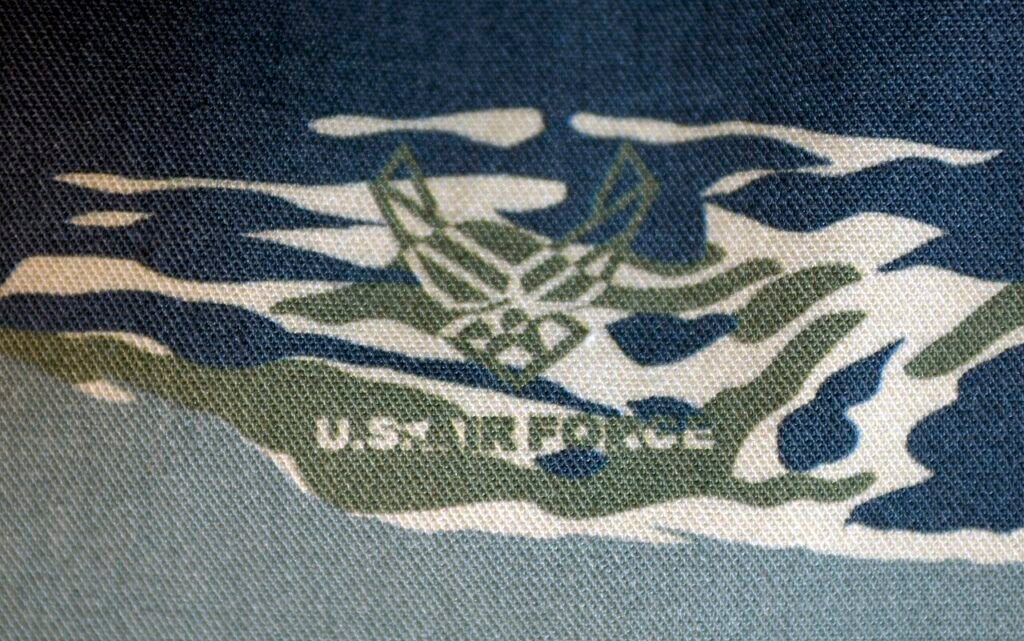
Conventional, non pixelated tiger stripe artwork modelled on the tiger stripe uniforms worn by airmen in the Vietnam War, recoloured into blues, greys and greens, with the small Air Force logo interspersed throughout the print, as the Air Force’s own caption for the pattern close up describes. The ensemble was a full utility uniform, blouse, trousers and embroidered undershirt, in men’s and women’s cuts, in wash and wear fabric, tested with grey no polish boots. The uniform’s features, fit, functionality and easy care, tested well; it was the colours that failed.
History
The prototype was developed at the direction of Chief of Staff General John P. Jumper, who wanted a distinctively Air Force utility uniform to replace the woodland BDU, and was unveiled in summer 2003. Wear testing ran during 2004: the Air Force’s announcement described 300 uniforms tested from January to July at nine bases, while press reporting described about 700 airmen testing over six months at up to 20 bases, and the two figures were never reconciled in the sources checked. The verdict was clear either way. The Air Force revised the colour scheme, in its words, due to feedback received from airmen; Air Force Times put it more bluntly in November 2004, reporting that widespread opposition from airmen about the proposed blue and gray tiger stripes drove uniform officials back to the drawing board. Commentators added that blue blends with almost no operational terrain, and that the design prioritised service distinctiveness over concealment. A second round prototype debuted on 2 November 2004: a semi pixelated tiger stripe with ragged, pixel like edges, trading the dominant blue for a subdued palette similar to the Army’s Universal Camouflage Pattern, khaki tan through muted spruce green, while retaining some slate blue. That revised design, finalised in 2006, became the Airman Battle Uniform, issued from October 2007 and worn until its 2021 wear out date, when the Air Force completed its switch to the Army’s OCP.
Identification notes
Smooth, curving tiger stripes in clearly blue dominant colours, with the small USAF symbol repeated in the print, mark the 2003/04 prototype. Against the adopted ABU: the ABU is semi pixelated, with ragged, squared off stripe edges, in a muted foliage green, desert tan and slate blue palette with far less blue. Against the U.S. Navy’s NWU Type I: that blue pattern is fully pixelated digital, not tiger stripe. Against Russia’s blue Tigr: a different stripe drawing, in a Russian interior ministry context.
Related patterns: ARVN Tiger Stripe Pattern, Russian Tigr Pattern.
Swatch image: U.S. Air Force, public domain, via Wikimedia Commons. The close up shows the prototype pattern with the Air Force logo interspersed throughout the print.