
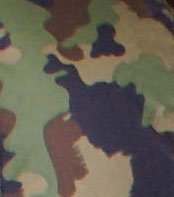
TAZ 90 is the standard camouflage of the Swiss Armed Forces. It keeps the blotch shapes of the older Swiss Leibermuster and prints them in a plain four colour woodland scheme, which makes it a useful lesson in how far colour alone can change a pattern.
| Country | Switzerland |
|---|---|
| Pattern type | Four colour woodland pattern |
| Introduced | 1993 |
| Status | Current Swiss standard pattern |
| Colours | Tan, brown, green, black |
| Used by | Swiss Armed Forces |
Design
The drawing underneath is the Leibermuster drawing, carried over almost unchanged. What changed is the printing: the red brown shapes and the white fleck layer of the old pattern were deleted, and the shapes are printed in green, brown and black on a tan ground. The result reads as a conventional woodland pattern at a distance, while the shapes themselves keep the distinctive Swiss character. ETH Zurich, the Swiss federal technology institute, was involved in selecting the colours to suit the Swiss landscape.
History
TAZ 90, short for Tarnanzug 90, entered service in 1993 as the replacement for the Kampfanzug 57/70 and the TAZ 83, and it has been the Swiss battledress and service dress pattern ever since. A 2006 revision, TAZ 90/06, added Velcro fittings for insignia and name tabs. A desert variant, TAZ 07, was produced for Swiss troops serving abroad on peacekeeping duties. A successor pattern, the Multiumfeld-Tarnmuster 16 (TAZ 16), has been in limited use since 2018 alongside the new MBAS equipment programme, but TAZ 90 remains the standard pattern across the Swiss Armed Forces.
Identification notes
Look for the Alpenflage blotch shapes in woodland colours, with no red anywhere and no white flecks: red in the print means the older Leibermuster, not TAZ 90. Against the newer TAZ 16, the check is the black: TAZ 90 has true black blotches, while TAZ 16 replaces the black with a light tan brown on the same geometry.
Related patterns: Swiss Leibermuster 1955, French Centre Europe (CCE).
Swatch image: public domain, via Wikimedia Commons.